Showing posts with label Al-faseela Articles. Show all posts

Thursday, November 15, 2007

Loyal Activists


Loyal Activists


Abduljalil Alsingace
15 November 2007


Amidst preparation for the UN universal periodic review (UPR[1]) which is to be carried out for Bahrain next April[2], the Government of Bahrain declared last Sunday to introduce a Human Rights Commission to be headed by a post of a minister. The commission is responsible for responding to the enquiries set forth by the UN OHCHR experts on Bahrain Human rights record, as well as interact with UN Human Rights bodies to explain and clear Bahrain stance with regards to its violations to many of the acceded covenants and ratified treaties.
A row over the establishment of "Human Rights Commission-HRC" according to Paris Declaration for the formation of civic human rights organization, but more seriously to HRC being Governmental, in its formation, members selection and tasks. As for the formation and task, it would not be allowed, what ever said about its independence, to cruise away from he Authorities plans and objectives. This is secured through the decree of formation, its financial funding as well as its selected members, which should meet the satisfaction and consent of the Bahrain premiere, as stated by the Foreign Ministry[3].

As for its advocates, Faisal Folath (Folad), the Royal appointed Shura member for over three terms, was seen to be declaring the progress and some "media" details about HRC. The Authorities established BHRW[4] after dissolving the "notorious" Bahrain Center of Human Rights (BCHR) in September 2004[5]. Folath is the regional director as well as the manger of the London-office of BHRW. He is a recipient of monthly allowance, as shown and mentioned in the first Al-Bander report[6], to form the Gongo "Bahrain Human Rights Watch-BHRW" and execute a plan to follow genuine Bahraini activists, propose and perform Authorities counter attack as well as report to the general manager of the secret mafia, Shaikh Ahmed Atteyatallah Al-khalifa – which was exposed by Al-Bander. Furthermore, Folath was among a group of loyalists united to combat activists and dissidents[7], including the Salafist Jasem Al-Saidi who called for rewarding the well known torturer, the British, Ian Henderson[8].
Folath affirmed these assertions when he stated today in Alayam newspaper that "I do not want to enter in the commission as I am a man of no "consensus" to others"[9].
Another striking piece in today's outing, is his statement that he and the group in his society –BHRW- are considering not to accept the appointment of any of its members when selected for membership in the commission, in the event selection of choosing Hassan Moussa for the presidency. He attributed the refusal of Moussa' nomination that "he is a diplomat having governmental affiliation. The HRC must be headed by an independent human rights activist". Hassan Moussa, resigned from the Bahrain Center for Human Rights and is currently working as a diplomat in Bahrain Embassy in London[10].
This piece of news about Moussa was alarming to me, as it rang a bill of what an officer in the OHCHR in Geneva was asking a Bahraini delegation about him. He, the officer, said that he found Moussa's attitude weird and could not correlate his identity he presents as being a member of OMCT, well-known organization based in Geneva, and his "intelligent" questions to the officer.

I made a little search in the library of the UN OHCHR to find that Mr Moussa was a member of the Bahraini official delegations[11], acting as an advisor, defending the position of the Authorities with regards to discussion of the reports of the CERD (Convention on Elimination of Racial Discrimination in March 2005[12] and CAT (Committee Against Torture) in May 2005[13].

These two gentlemen could be activists, but definitely loyal, for an agenda laid down by the Bahraini Authorities, as exemplified by the privileges and resources under their disposal. They, however, must be rewarded for showing loyalty, efforts exerted and the role they play. Being a president at the post of a minister, or just a member of the Governmental human rights Commission would the least accepted for being a loyal activist. Being loyal, do they have the choice to refuse or dispute?

[1] http://www.ohchr.org/english/bodies/hrcouncil/upr/index.htm
[2] http://www.ohchr.org/english/bodies/hrcouncil/upr/upr1stsession.pdf
[3] http://www.alayam.com/ArticleDetail.asp?CategoryId=2&ArticleId=290819
[4] http://bhrws.org/index.php?pageid=5
[5] http://www.alyaum.com/issue/article.php?IN=11430&I=212003
[6] www.bahrainrights.org/node/528
[7] http://www.aafaq.org/search_details.aspx?id_arch=129
[8] http://www.aafaq.org/search_details.aspx?id_arch=7435
[9] http://www.alayam.com/ArticleDetail.asp?CategoryId=32&ArticleId=290858
[10] http://www.alayam.com/ArticleDetail.asp?CategoryId=32&ArticleId=290858
[11] http://mail.google.com/mail/?attid=0.1&disp=inline&view=att&th=11500dce0c865309
[12] http://www.ohchr.org/english/bodies/cerd/docs/CERD67/66list-bahrain.pdf
[13] http://www.ohchr.org/english/bodies/cat/docs/bahrain.pdf

Wednesday, June 27, 2007


When live ammunition is the solution
Abduljalil Alsingace
June 27, 2007

In a peaceful protest, many national figures - political, human rights and feminist - Shiites and Sunnis, declare for a march Saturday afternoon (June 30th) from Ras Al- Ramman Grand mosque towards United Nations House in the capital Manama, in protest over the decision of the UN Commission for Human Settlements to honor the Bahraini Prime Minister Sheikh Khalifa bin Salman Al Khalifa for his achievements in this area.

The notification for the protest march was taken the relevant police station, as usual. The Ministry of the Interior (MOI) has made several excuses, including the inexistence of the director or officer of Legal Affairs, in order not to receive it. The decision was then made to send the notification by fax, only then the MOI accepted to receive a copy of the notification, but with the following threat:


"The march would be prevented by force and showered by live ammunition, will include participants, and also organizers of the march."

The organizes of the march include: Mr Isa Aljowder, Mr Hasan Mushaima, Mr Abdulhadi Al-khawaja, Sh. Mohamed Al-Mahfoodh, Mr Nabeel Rajab, Sh. Abdulla Al-Saleh, Mrs Layla Dashti and Dr Abduljalil Alsingace.

It should be noted that honoring the Prime Minister will formally take place in the presence of Secretary General of the United Nations on July 2, 2007 in the United Nations Economic and Social Council in Geneva, Switzerland.

IT is apparent that the Regime decide to change attitude and deals with his opponents and those who disagree with his symbolic figures, who do not enjoy popular support, with a new style.
It is evident that the Regime is not tolerant with peaceful protests, how small they appear, which have become embarrassing. It will not hesitate to resort to weapons and live ammunition, to restore the memory of what happened during the nineties to the two young martyrs - Hani Al-Wasti and Hani Khamis. They had been sniped by assassinate from a helicopter during a peaceful demonstration in Sanabis -west of Manama, on December 17, 1994, during a meeting of the Gulf Cooperation Council.
That coward assassination resulted in a series of protests leading to around 40 martyrs-inside and outside the prison, arrests of tens of thousands, and the foundations of the political crisis stifling until 1999.

Will the Regime, foolishly and unwisely, restore the same old method, reopening the same page, and continue to systematically deal with security mentality and excessive force-even causing loss of life - in front of peaceful protests that the world is witnessing ?

Waiting to monitor what happened next Saturday, and how officials deal with the march and the impact it will have on the award ceremony, Sheikh Khalifa bin Salman is looking for.

Will the Regime click and launch another convoy of martyrs in the so-called “Reform era”?

We wait and see!!

Thursday, March 15, 2007

Action Plan for Resettlement of Indigenous People of Bahrain


Action Plan for Resettlement of Indigenous People of Bahrain

Abduljalil Alsingace
12 March 2007


English amateur translation of “Naturalization Challenges: Estimates and Indicators”
The third chapter of “Bahrain: 2005-2010, the first part of the Plan of Action of Secret Web”

Summary:

In the first week of January 2007, the UK-based Gulf Center for Democratic Development (GCDD) issued its second report (compilation of confidential documents) about secret plots conspiring against the people of Bahrain. The plots are lead, managed and financed by institutions and members of the ruling Al-khalifa family.
The 240 pages report, titled: “Bahrain: 2005-2010, the first part of the Plan of Action of Secret Web“[1], is composed of six main Chapters;
· The first chapter, titled Containment of Scholar “Olama” Council, includes a detailed plan for activating the role of the security services in tightening its grip on the Shiite religious organizations, places of worship, charitable organizations and its cultural and social frontages.
· The second chapter gives an overall perception of the methodology the State, represented by the Royal Court and the executive bodies to unify addressing the issues of concerns which involve the constitution amendments, naturalization, political societies code, law for family provisions, judiciary and endowments.
· The third chapter is concerned with the priorities for the naturalization challenge and the need for a strategic decision in which the “exception” in granting citizenship to prevail over, and consider meeting naturalization requirement as being the exception. It monitors the priorities in targeted nationalities as sources of naturalization, and sets the requirement for naturalization of 50 thousand people per year, starting by the year 2005, so that a sectarian balance is achieved by the end of the year 2010.
· The fourth chapter focuses on laying down necessary steps to rehabilitate and contain civic societies, by empowering mechanisms of the Ministries of Social Affairs and Justice. It also shed light on the re-injection of military employees of Ministries of Defense, Interior and the National Guards in the civilian life in order to undermine and curb the civic organizations.
· The fifth chapter is concerned with the strategic plan to orientate youths, the ways to keep them from the influence of religious leaders, and identifying alternative incubators for enhancing the youth’s loyalty to the Regime.
· The sixth chapter focuses on the role of the American Embassy in Manama, the way to contain its activities and influencing its support for civic organizations in the light of Democratization Law. This covers the plan to expel National Democratic Institute (NDI) from Bahrain and the mean of impinge on the reporting of the Embassy.

Remarks:

Below is an amateur English translation of the action plan meant for resettlement of indigenous people of Bahrain. Some basic remarks are noted:
The first part covers abridgment of the need for naturalization and concluding that irrespective of the practiced legislation in many countries, Bahrain should resort to further extend the privilege to the head of State and empower him to accomplish demographic manipulation within certain framework. This is justified by the imbalance in the demographic status and its danger on the future of the regime and its sovereignty!
· The second part covers how the Regime looks at reproduction of Shia in Bahrain and who all guided and supported attempts to compete that growth by Sunnis fail. It also gives a chart showing the Sunni and Shia population growth, and the alternative schemes (required naturalization number) to over turn the Shia imbalance. It concludes that the plan should focus on granting nationality to “strategic” 50 thousands of “loyal” Sunnis per year. This plan should be completed by the year 2010.
· The next part evaluates the alternative sources, types (characteristics) of nationalities and the expected possible number to be imported to Bahrain.
· Next is a media campaign guidelines to obtain advocacy and support of the local Sunnis as well as opposition.
· The possible recommendations out of alternatives brought forward previously, are laid down.
· These are summarized in a table showing the expected number of Sunnis of the targeted nationalities.
· The challenges and policy facing granting nationality to Asian migrant workers.
· The chapter concludes with forming a standing committee chaired by the head of the Royal court: Sh. Mohammed bin Attiyatallah Al-khalifa
· Introducing this issue in the house of deputies should be prevented at all costs.

Translation:
“Naturalization Challenges: Estimates and Indicators”

· Acquiring nationality: legal + political relationship between Bahrain and any naturalized individual (loyalty)
· Any grant of citizenship aim is to take place, taking into account the protection of Bahrain's security National (population balance + sectarian + ethnic).
· There are conditions (written + oral) defines the executive framework (public + private + exceptional) through which the naturalization process is upheld. The ultimate goal is to facilitate opportunities for the integration and rapid adaptation among naturalized.
· knowledge used in the state is a true proof of merge or susceptibility to thaw in the society.
· There are other additional conditions, for example, Syrian law makes sure the integration of the naturalization applicant, where he request, as guarantee requirement, to replace his foreign name with Arabic one, while Saudi Arabia obliges conversion to Islam, without it would be considered concession prejudice to the root of its entity.
· General Conditions (West and East except Israel) are not for the naturalized to be burden on the State (Financially, Ethically or health wise) and to have the minimum characteristics of a citizen. It is favored that he/she has a legitimate source of earning, and a minimum level of education. It might be preferable for him/her to have a capital (Western Countries), registered real estate (Bahrain) or expertise which could be useful (Syria + Egypt) etc.
· The most important condition, which should not be conceded, is loyalty to the State, respect its systems, and the integrity of the political system or State entity (Economic + community + political).
· All States define a minimum residency so that it could be considered in the application of the naturalized, 5 years (France + Japan + Britain + Tunisia), 10 consecutive years coupled with the knowledge adequate Arabic language, and Arab origin (Bahrain), Islam (Saudi Arabia), 15 years (Oman), 20 years (UAE + Qatar + Kuwait), or 25 consecutive years of non-Arab (Bahrain).
· Number of years of residence, could be reduced in some cases. UAE grants citizenship to the citizens of Qatar, Oman and Bahrain, after three years of residence. Qatar, however, considers the application of Arab resident, when staying for a period of seven years.
The case of Bahrain needs a strategic brave decision to make the exception (in granting citizenship) prevails over meeting the conditions, which should be made the exception. This is for reasons relating to the particular conditions in Bahrain, the most important of which is the imbalance in the demographic status and its danger on the future of the regime and its sovereignty.

Initially, naturalization, a political right of any State, is not governed by any international charters and covenants, until now. Each State has its own policies, consistent with its needs and national security priorities (economic + political + social, etc. Bahrain is not in isolation from the rest of the world.

Bahrain, its identity, future of its generations, its culture and history are on the line, if the sectarian demography flaw stayed prevailing.

Shiite, through its tools (education + work + birth), in addition to other factors (Sunni Migration to neighboring states + migration of Shiites to Bahrain), was able to reverse the percentage (Shiite to Sunni)during 20 years (see 1941Census) .

The Shiite leadership (religious/political) put the issue of "nationalization" at the top of its provocative and inflammatory agenda (social bombs) to continue its current control (economically + population) and consider it a guarantee to impose political control and seizure over the regime.

The "naturalization" issue is one of the most important primary pillars in opposition discourse and is directed to implicate external provocation against the Kingdom and its symbols. It will remain on the agenda in the foreseeable future. The opposition is currently active in the formation of a "national committee to combat naturalization" and is working to amend the 1963 nationality law in order to achieve full control of the naturalization process. It also aims to codify preventing the naturalized of exercising the political right of nomination, election and managing a public office. The objectives of the opposition (Secular+ religious Shiit) is to impose its agenda aiming at affirming dominance of Shia sect on the future of the country and provoke racial as well as sectarian sentiments to serve its political objectives.

This was evident from the primary recommendations of the Naturalization committee, formed by the House of Representatives (May 2004), and the most important points were:

· ascertain the fulfillment of applicants for naturalization conditions specified in 1963 law (public + private + exceptions to the Majesty the king).
· forming a regulatory body to follow up the steps to grant nationality.
· specifying clear criteria for the exception cases.
· Limiting naturalization only to the actual needs of the State.
· Disclosing orders granting citizenship, its withdrawal and abolishment in official Gazette.

The State has exhausted efforts to overcome these recommendations and avoid non-compliance.

• Naturalization file shall resurface strongly in September 2005, after a period of six months granted by the House of Representatives to the Minister of the Interior to respond to the report of the Special Committee investigating the matter.

• Shia depuites Abdulhadi Marhoon + Ali Al-Samahiji + Abdulnabi Salman + Mohammad Abbas Al-Sheikh + Jassem Abdulaal will exploit the "nationalization" file, in a dirty manner, as Bahrain enters the electoral battle in 2006.

The following chart shows the difference, in numbers between the population of the two sects (Shia and Sunni), will continue forever. It would create a state of escalating sectarian confrontations and encourage targeting the regime, if things persists unchanged.
The alternative option should bear in mind the outcome of currently prevailing procedures aimed at changing the population demography. They are:

Focus on the naturalization of expertise (Arab and foreign). The number is small, and does not exceed at best 2000 case per year. The families of these competencies are usually small (number of children do not exceed 3).
The cases, currently under consideration, at best and of all groups, do not exceed 25 thousand application. It is estimated that it will not contribute significantly in changing the situation. During 6 months of 2003, for instance, the naturalization cases did not exceed 7300.
The proposal to facilitate for the conditions of the dual nationality with Qatar, at best, will add not more than three thousand naturalized. The issue becomes more moral than practical, especially with the desire of Qatari Authorities not to grant nationality to the "Baharneh"- Shiite Bahrainis.
Dual citizenship with Saudi Arabia didnot not produce more than 15 thousand naturalized. In the previous elections- meaning 2002 election- their effect was very limited in constituencies, but was its political exploitation was frightening.
Continue to negotiate with the tribes of Saudi Arabia to support dual naturalization. This will provide, at most, 60 thousand people, but most of them will not move to Bahrain and will just act as reserve, for periodic "urgency".
Collective marriage. Despite its low cost (340 marriages cost 30 thousand Dinars), its impact, at the end, is more than limited. For example, the Islamic Education Society (Salafi), a leader in the collective marriage project, facilitated collective marriage of about 2500 marriages, during the period from 1992-2005. Only 70% of the marital relationships lasted and contributed in increasing the number of the Sunni population of 6 thousand child during the 13 years.
But the Shiite community encircled this project, adopted the same idea and applied it with effectiveness. They managed to secure internal and external support (UAE + Kuwait) – for the collective marriage project- and organized joint events by it charity funds, to facilitate, in one month (May 2005), 700 Shiite marriage cases against 300 Sunni cases in that year. Not to mention the cases of marriage (temporary “mutaha” or permanent), which are increasingly promoted during Ashura between the Shiites men of Saudi Arabia (From Hasa area) and Al-Baharna women!!

Despite the importance of continuing and ensuring not naturalizing Shiites of Iranian or Iraqi origin, because of its justified danger to the national security, and because the loyalty of these is questionable (loyalty is to Iran and not to Bahrain). However, the current procedures allow naturalization of these people on an average of one thousand individual a year. We believe that effective option must consider the experience mentioned earlier, in particular the Israeli experience, benefiting from its course and the difference in circumstances.

When Israel felt that number of Jews immigrants from the Western countries constantly decreased, because of the decline in the standard of living in Israel compared with the Western countries, it (Israel) headed towards Eastern Europe and managed in a short period of time grant citizenship to more than a million citizens of Russia alone. Then it went towards Africa, and obtained nearly 300 thousand Flasha Jews from Sudan and Ethiopia, as well as about 150 thousand from South Africa. Now, they are heading to India, where they discovered Indian Jewish group there!

In order for Bahrain to achieve the required balance, it must consider naturalization of 10 thousand Sunnis per year would not, absolutely, affect the currently prevailing the relation (see the chart in p.5). If the number was raised gradually to 20 thousand per annum, it could succeed in amending the demography at the end of 2016. If, however, the number was raised gradually to 50 thousand per year, its capability to alter the population composition could be realized after the year 2010. In our judgment, this is the only strategic option.

The legitimate question is about how to implement that arrangement before the eyes of the opposition, and its ongoing campaigns.

From media perspective, firstly: the topic should be presented as part of the strategic objective to preserve the identity of Bahrain, as stipulated in the National Action Charter (NAC) and the Constitution, confronting schemes designed to naturalize Asian expatriates in the Arabian Gulf (see page 10).
Secondly, highlighting the matter in relation to revitalization and strengthening the Bahraini community, as well as the achievement economic growth and stimulate social interaction to combat opposition allegations that it will cause social fragmentation and low level of income. The main objective to focus on the gradual coverage of the (naturalization) issue is to raise the pace of Sunnis response and their support to this strategy, while activating its role in the national arena through the emphasis that the (naturalized) are of the (trustworthy).

Recommendations

- The focus should be on three main sources to push the naturalization process: Iraq Sunnis, Asians focusing on Baluch, Bengal and Yemenis. Most of these nationalities dream of better economic opportunity in Bahrain.
- Currently, there are more than 120 thousand Iraqi Sunni in Jordan fugitive from tyranny and Shiite persecution in Iraq . Making use of this quantity in facilitating the presence of at least 30thousand of them in Bahrain. Despite the roughness nature of the Iraqis compared to the Bahrainis, this will help in elevating the temperature (heat) of the Bahraini Sunnis. They will provide the practical proof, that the fate of the Sunnis in Bahrain will not differ from that of their Iraqi brothers, if Baharneh (Bahraini Shiite) were allowed to take control of the country. At the same time, there is the positive psychological impact.
- Discrimination and persecution facing Iraqi Sunnis, since the fall of Saddam, is still virtually undisclosed in all parts of the Islamic world. Bahrain can be used this in its propaganda campaigns, directed internally, to pre-empt the current Shiite schemes
- Sudan's population is 30 million. There are no less than 700 thousand Sudanese expatriate in SAUDI Arabia+ UAE + and Sultanate of Oman from different professions and a specialties (labour + professional). Although their economic circumstances in those countries are better, the temptation to obtain the Bahraini nationality, resettlement and the stability of their families in Bahrain did not attract many of them. They are often not inclined to obtain citizenship for psychological reasons.
- There are about 200 thousand Sudanese now living in Egypt, escaping the situation in Sudan. Most of them are registered with the United Nations High Commissioner for Refugees and the International Migration Organization in you procedures were resettled in Canada + Austria + of the mandates of the United + States Scandinavia. procedures Altot Yen long and complex and a 5 - 3 years. This could be considered in order to provide a source of large numbers eligible scientifically.
· The third source is Yemen, which has a population exceeding 21 million. The high percentage of education and low level of income make immigration a primary choice for most Yemenis. Bahrain has been attractive place for them, in the light of Saudi intransigence towards their entry to the Kingdom.
· The surplus population of Other Arab countries, especially Jordan, Yemen, Syria, Egypt and Morocco could be used to provide 15 thousands annually. The focus here would be on those born in Kuwait and Saudi Arabia (Stateless or “Bedoon”), for ease of harmony with Bahrainis and gain of habits of the Gulf
· Systematizing a proper mechanism to attract these competencies and human resources who have been examined (socially + politically) in the past and their characteristics matched with that of the Bahraini society.
· A plan, set to process and accept applications for naturalization, has been adopting flexible regulations in its review and evaluation, through grant Bahraini nationality by reducing the number of years of residence in Bahrain to three years for Sunnis of Arab descent. This may raise the current number to about 25 thousand eligible for citizenship at the very least. Based on these recommendations, the sources of naturalizing Sunnis could be summarized as follows: (See Table).
The Challenges of the Demographic Status

¯ Bahrain is no exception. It is today, as was during previous centuries, representing a melting pot of cultures, races and ethnics
¯ The National Action Charter and the Constitution reference hold a special consideration represented by its Arab and Islamic identity and reinforce its links in the regional environment, in the light of clear loyality in the Arab Gulf Cooperation Council at present and by fate.
¯ In the policy and laws to grant residency for foreigners, (Bahrain) adheres to international standards, and is not different, in essence, from those applicable in the United States or the European Union (Article 17 of the Constitution).
¯ Within a decade, the population density in Bahrain increased from 532 to 909 person. Thus the compatibility should be considered between population and economic growths. Therefore, as do all states of the world, the policy of the Kingdom of Bahrain is the sustained attention of the population issue. This was a difficult challenge at time of independence and sovereignty, which was concluded by the Security Council in 1970, when Iran, then, claimed affiliation of Bahrain and worked on the entire demographic change and obliterate the identity and features of the Arab and Islamic countries and the pillars of its sovereignty and national well.
The Bahraini Policy
The Bahrain's strategic objective is controlling the rapid population growth and support opportunities for increasing number of Sunnis in order to preserve the national identity, Bahraini culture and social cohesion. It is a policy based on the principle of swift decision-making, through reducing foreign employment and kept at a minimum level while treating the economic situations and activating a strategy addressing unemployment by opening migration opportunities for the Shiite, whatever few in number, and the maximum utilization of foreign competencies necessary for Development.

The State is studying the population impact for any imbalance in the demography by revising laws, regulations, governmental programs, as well as health and education services before implementation within the framework of retrieving the law. It also seeks to link training and education outputs with the needs of sustainable development and encouraging Sunni women to enter labour market, considering the privacy of the community and its traditions, as the vast majority of the female work force in the labor market is Shiite.

The Bahraini Constitution (2002) in article 17 states that: ”a-Bahraini nationality shall be determined by law. A person inherently enjoying his Bahraini nationality cannot be stripped of his nationality except in case of treason, and such other cases as prescribed by law”. The naturalization process is subjected to the sovereign supervision according to “Bahrain Nationality Code” of 1963 and its amendments.

The same constitution states (Article 18): “People are equal in human dignity, and citizens are equal before the law in public rights and duties. There shall be no discrimination among them on the basis of sex, origin, language, religion or creed”. Therefore, there is no distinction between the indigenous Bahrainis or those naturalized, in all circumstances.

Long-term risks
In addition to the domestic challenge of sectarian imbalances and its political repercussions, there is the danger of the groups of Asian migrants to the Gulf states. It is known that the labour Asian groups migrated to South Africa, the Caribbean Islands and Fiji became, later, settlers then to citizens, a case occurred in a period of 20 to 30 years of demographic change of these countries, then to rulers through the democratic game. Another case is the Chinese employment experience in Vietnam, Malaysia and Singapore, and their control over the economy. In Singapore, and within a decade, the Indian migrant work force gained recognition, political, economic and social power, surpassed all imagination. In different historical circumstances, the French community turned into political and economic power in the West Arab countries. The Persian migrations to Iraq, during the eighth decade of twentieth century, caused a serious problem. The experience of the White settlement in South Africa and Jews in Palestine, are all cases worthy of consideration.

The demography in the Gulf Cooperation Council States is occupied, as a result of long-term policies and migration overlap among tribes and citizens of these countries. During the period of instability, climatic changes and scarcity of resources, large populated groups moved in the Arabian peninsula, Iran and Iraq, and in opposite directions.

After discovery of oil, the region became attractive for foreign labor from all over the world. Today, the foreigners constitute 85% of the population of the UAE, 80% of Qatar, about 35% of Saudi Arabia, Oman, and Kuwait, while they are about 38% in Bahrain.

But at the time of accelerating the democratic transformations in the Gulf and the corresponding policies of globalization, it seems that the settlement project of Asian labour migrants find future protection from military alliances and international organizations, operating under various names. The most serious was the United Nations Universal Declaration for the Protection of Minorities, the ILO successive resolutions backed by the labor-exporting countries, number of decisions issued by the European Union and the leadership of NATO in this regard. What happened in the Balkans are sufficient evidence, without the need for further elaboration. We are now entering a phase where local matters can not be separated from the regional or global one, how small it is. From here, it is necessary to look at the future of the heavy presence of the Asian employment, as a timed bomb that threatens the stability of the entire democratization projects in the region.

We bear this in mind, so that the imbalance in the population composition doesnot contribute in the destabilization of Bahrain and its sovereignty. These concerns have been consistent with the regional efforts, spearheaded in the past, in particular, Iran and India and international attempts working to secure the appropriate climate to impose granting citizenship and equality of rights and duties of the Asian and Persian communities under the pretext that this will help to the security and stability of the political system in the Gulf states. Also, for a period of time, legitimate concerns prevailed over the political role the overriding foreign presence will have, instigated by external forces exploited for foreign intervention to protect and insure the interests of these communities. The growing trend among some Western countries, and its attempt to put on its agenda the issue of resettlement of Asian labour migrants in the framework of the situation rearrangement of the Arabian Gulf region, is an issue since the mid-ninth decade of the twentieth century. It is a milestone project buttressed by political and research institutions as well as organizations working in the area of human rights and protection of minorities.

This project has gone beyond the stage of contemplation to the stage of advocacy in the decision-making circles in some Western countries and put forward as one of the means of dissolving the Arab and Islamic identity, midst migrant groups of different religions, cultures and origins. This will serve to transplant the nucleus of pluralism and its maintenance in the womb of societies of purely Islamic, Arabism intolerant, and of a tendency towards extremism and terrorism. It is mandatory to use this information to neutralize the posture of the Western countries against the opposition campaigns.

Formation of a standing committee under the chairmanship of Sheikh Mohammed bin Attiyatallah Al-Khalifa, Head of the Royal Court
This project can be dealt, only by dual media campaign intensifying the awareness of the dangers of the Asian communities on Bahrain, as a political cover, while gradually replacing the Asian employment groups by the naturalized in the framework of the recommendations to address the demographic imbalance between Sunnis and Shiites in Bahrain;
Under any circumstances, any opportunity to open the “naturalization issue” in the House of Deputies should be prevented.
he Bahraini Policy
ndards. s, tr the sake of securing life for Mosa Abdali.all flved in the above activities.lifa ruling famil
[1] http://up.9q9q.net/up/index.php?f=YyWsqpOmL

Saturday, November 25, 2006

BANDARGATE

BANDARGATE.. BANDERGATE

GOVERNMENT SHOULD LONG NEGATE…… BANDARGATE.. BANDERGATE

INCITNG COUNTRY WITH HATE…… BANDARGATE.. BANDERGATE

BAHRAINIS REFUSE SUCH FATE…… BANDARGATE.. BANDERGATE

GRANTING PASSPORTS WITH HGH RATE…… BANDARGATE.. BANDERGATE

HATE AND TERROR WHEN THEY MATE…… BANDARGATE.. BANDERGATE

KILLING, SLAUGHTER EASY GATE…… BANDARGATE.. BANDERGATE

CHAEOS, UNREST WILL NOT BATE…… BANDARGATE.. BANDERGATE

BANDARGATE.. BANDERGATE


Wednesday, November 22, 2006

time to go, khalifa

After 35 years:
Time to go, Khalifa

Abduljalil Alsingace
20th November 2006


Shaikh Khalifa Bin Salman Al-Khalifa has been the only ever Bahrain prime minister, since the formation of the State in 1971. Over the past 35 years, Bahrain has witnessed many crisis and is the only unstable Arab State in the Gulf. Under Sh Khalifa premiership, Bahrain has been through a continuous turmoil as a result of his policy and running of the day-to-day business of the country, leading to a SINGLE conclusion and that it is time for him to step down, and allow the people to choose their own government.

During his premiership, the following may be taken as pointers to his style of leadership:

1) Sustained State Security measures:
He Government was responsible for eradication of 1973-75 parliamentarian council and enforcing State Security law and its jury, which was responsible for the killing and execution of scores of citizens, the forcible exile of hundreds and imprisonment of thousands of Bahrainis. These measures are now being resurrected in new pseudo democratic format, under the existing half elected consultative council. Since 2003, demonstrators, activists and protesters have been dealt with using the old repressive techniques; Special Forces, public prosecution and the judicial system, in conjunction with the law: the Penal code, the Gathering (old and new) code, Press code and recently Terrorism code. Detentions and imprisonment have become normal occurrence: Abdulhadi Al-khawaja, detainees of the societies petition, Bahrainonline directors and other bloggers, Bahrain Airport demonstrators, Dana Mall, and last but not least, Publications detainees (Dr Mohammad Saeed and Husain Alhebshi).

These measures played a major role in the instability and unrest during the past era, and will definitely lead to more troubles ahead, once activated. This could be avoided by changing the mentality by which things are being run in Bahrain.

2- Sectarian sedition:
Sectarian discrimination and favouritism have been practiced as “unwritten Law” during Sheikh Khalifa’s reign. It is now known that certain ministries are classified as Sunni and others as Shia. Religious freedom is orientated to cause maximum humiliation of the followers of one sect, but not the other. Favouritism and incentives are linked to the loyalty to the ruling family. The last Government re-shuffle brought 22 ministers: 11 ministers from Al-Khalifa, 6 Sunni ministers and 5 Shia ministers. Is there a more sectarian and favourite post allocations than this?

2) Corruption:
Under the supremacy of this Government, corruption has been encouraged and its extent has become so diverse that it has caused a real moral crisis in the government. People and media speak ofcorruption, but nobody is able to do something about it as it is sheltered by well-known and influential individuals in this Government, including the PM. They are simply untouchables by the media or the law. On one side, huge buildings are erected in certain parts of Bahrain indicating exceptional and questionable wealth, whereas on the other side, people have nothing to eat or place to shelter. As a result, signs of popular frustrations and bursts, resulting from corruption-related policies and programs, have become a worrying development. To what extent can this outcry be suppressed and controlled? nobody knows!

3) Housing problem, poverty and land appropriation
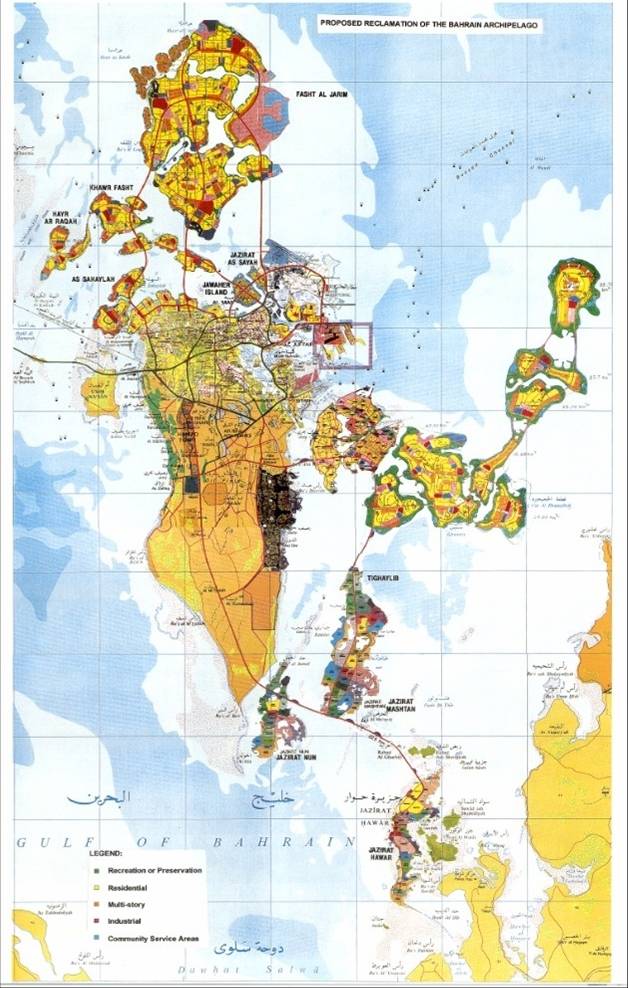
During the time of this Government in power, most of the public lands have been embezzled by corrupt elite, led by the PM himself, leaving only 7% of Bahrain’s land for public. Whole islands have been confiscated by the PM and his cronies, and converted into private ownership. As a result, no area has been left for building houses for citizens. Furthermore, national funds have been allocated for reclamation of see, but had been misappropriated and invested in the open market, by members of the ruling family. Who else (but the PM himself) could have appropriated the old Manama sea port and converted it to a private “financial harbour”? Who else could have embezzled most of lands in main island and sea, while the trail of housing applications has reached 45,000, going back as to the nineties. There is now no place to build houses for Bahrainis but the PM can always find lands for mega million projects to pour in the pockets of specific members of the family. One wonders, who is locally known as Shaikh Bahar or “the sheikh of the sea”?
When there is no place to construct houses for people, then it is expected that other alternatives are to be thought of. This is not envisaged by the present Government, as indicated by the continued rise in the housing applications.

4) National revenues from oil, gas and others, who pockets them?
With the unemployment predicament (the Government recently opened recruitment offices in Qatar and UAE for Bahrainis), housing crisis, underpaid jobs, t a social security system will could have been established to reduce the gab between the inferior services offered by the present Government and public rising resentment. Oil revenues could be used to support such fund, but nobody knows where the difference between the market price of oil of around $70 and the $30; the Government declared value. Who else, other than this Government, knows where the difference, which makes billions of dollars, would go?

5) Bandargate
Browsing through the report of the Gulf Democracy Development Center, known locally by “Bandargate”, the Government would certainly appear guilty, with its deep involement in supporting, financing and managing the “sectarian sedative” web, led by Ahmad Attiyatallah Al-Khalifa, minister of cabinet affairs. This Government-led “Mafia” aims at introducing and fuelling sectarian sentiments among citizens and prepare the environment for another “Iraq” in Bahrain. The least the Government could do is to resign with immediate effect, and allow an international independent enquiry into the matter. It simply has lost the trust of the people.

Concluding remarks:

There are many issues that make the present Government unfit to remain in office. Some of its members have been mentioned, without further elaboration.

The current Government, led by Sh. Khalifa, has been run by single and only one mind. It has proved to be failure, infertile and ceased to provide genuine solutions for the citizens’ day-to-day concerns. It has been a major factor in the worsening situation by planning to create politically volatile and instable condition.

It is time that this government and its head depart the scene, and allows the people to choose their own government.

Friday, August 25, 2006

By the KING.. for the KING

By the KING.. for the KING

Dr Abduljalil Alsingace

23rd August 2006

House of Lords, London – UK

After all the promises and vows made in public by Shaikh Hamad Bin Isa Al-Khalifa to maintain and respect the socially binding constitution of 1973 and the constitutional coup carried out by him on 14th February 2002 is that he wanted to ensure that he is got it all. His ego is to be called by “ his majesty the KING”.

His majesty wanted to ensure that ruling Bahrain is restricted and maintained in his descendents, so they would be called “princes”. His majesty wanted to solely distribute the national wealth among his family to maintain their loyalty and support.

His royal wanted to convert Bahrain into private property: giving pieces of lands and sea shores as souvenirs to members of the ruling families in the Gulf (Al-Sabah, Saudis, etc). He is after changing the demography and smudge the historical and cultural genuine identity of Bahrain by “importing” citizens from certain tribes of Deir Zour of Syria, Sahara of Jordon, Saudi Arabia, Yemen and Baluchestan.

His majesty perceives Bahrain a dynasty but for non-indigenous people (Shia and Sunni). Because of his systematic policies, they are deprived of all means of dignified and decent life- poverty, homelessness, speechlessness, and utter silence, only when his majesty gives, grants, allows, permits and honours. He unilaterally abolish the contractual constitution, a document which descends from people, and is meant to be for people. He tailored made his own in 2002 and imposed it on the people of Bahrain. It is by the KING and is made for the KING.

Such approach, considering the persistence and indigenous struggle of Bahrainis going back to as early as 1920’s, will not help paving the path for sustainable stability and security in Bahrain. More democracy and freedom will fulfil such requirements and not by marginalizing and alienating Bahrainis from the decision making. 2002 constitution- unilateral imposed by Shaikh Hamad- simply focuses all the power at the hand of his majesty the king and leaves people in the shadow. This what has materialized for the past four years of the half-elected Shura council.

The people of Bahrain have signed the biggest petition in the history of Bahrain (82,000 adult signators out of 460,000 Bahrainis) calling for new democratic constitution to be drafted by them, and addressed to UN Secretary General Kofi Annan. In this petition, the signators refuse the “By the King for the King” constitution of 2002 and want “By the people for the people” constitution.

This grand constitutional petition is a strong voice calling for appreciation for the existence of indigenous (Shia and Sunni) people of Bahrain and their rights calling for true democratic constitution. It is an ecko to the demands sacrificed for by trails of martyrs among them Bu-Nafoor, Ghuloom, Shaikh Jamal, Jameel Al-Ali, Dr Hashem Al-Alawi, Hani Khamis, Nedhal Nashaba, Fadel Abbas, Nooh and others. It is a loud scream saying, we “Bahrainis” are here, donot alienate us or marginalize us. We should be considered when running business of Bahrain. We call for our rights to be restored and respected. We are after the life of dignity and decency away from the life of slavery dictated by the current ruler. We want our life back. We want to write our own constitution.

Thursday, June 08, 2006

HUSH

HUSH

Abduljalil Alsingace
Bahrain: 8th June 2006

In almost a month, the Bahraini Authorities have sent different messages reflecting its maneuvering capabilities granted by Shaikh Hamad unilateral constitution of 2002. This includes legislative aspects; as in the case of passing Gatherings code, altering internal bylaws of the elected council, and the upcoming Terrorism Code. These signals covered constraining any oversight capabilities which has been exemplified by the urgent hand-over of the State budget for the years 2007-2008 and prohibition of questioning Ministers in public. Amidst these messages, one might wonder if this is the end of it, or would there be more tools? Does the elected chamber possess any capabilities to counteract these State measures?

Gatherings Code:

Because it was appalling, and due to exerted pressure outside the elected council, the State has backed down on its first draft for a new Public Gatherings code. Rather, the State recently introduced amendments to the old Gatherings Code (Decree No 18 of the year 1973). These changes introduce constraints on the freedom of expression and association in any form of public gatherings: processions, sit-ins, and even meetings in private household deliberating on public issues. It grants security individuals the privilege to intervene and call off any meeting on the basis of “endangering or disturbing State security and/or public order”. Those who show any form of disobey or violation to an order of annulling a meeting could face an imprisonment a month to a year or/and a fine of Bahraini Dinar 50-200 (US $ 133- 530), as per the new amendments.

This Code infringes the essence of rights, called upon by the universal declarations and the Convent of Civil and Political Rights. This Code has been passed by the Elected, to the Appointed Chamber (of State Appointed Members), which is not expected (cannot or allowed) to defy or reverse it back.

Handing over the next two years budget-on urgent basis:
There are two aspects of the State behaviour with regards to handing over the budget urgently at this time of the Elected chamber life span. The first is to apply pressure on the Elected members to enter in a deal or compromise to let go the budget with maximum ease. The second, is the fact that passing the budget in this hasty way, giving the elected chamber only 15 days for a discussions, deliberations and enquiries, as per Article 87 [Budget] of 2002 Shaikh Hamad constitution, which postulates that
” Every bill that regulates economic or financial matters, and the Government requests its urgent consideration, shall first be submitted to the Chamber of Deputies so that it takes a decision on it within fifteen days. When that period elapses, the bill is presented to the Consultative Council with the opinion of the Chamber of Deputies if there is such an opinion, so that the Consultative Council decides on it within a further period of fifteen days. If the two Chambers should disagree on the bill in question, the matter is referred to the National Assembly for a vote on it within fifteen days. If the National Assembly does not reach a decision on it within that period, the King may issue the bill as a Decree that has the force of a law.”
In actual fact, this could not be done in the prescribed period.

Now, why the State is opting to pass the next two years budget in this manner, could be attributed as follows. Firstly, to ensure that the next elected chamber has no oversight jurisdiction or enquiries concerned with the approved budget. Secondly, approving the ‘bonanza’ budget over a short period by elected members of an acquaintance with the government. Thirdly, the possibility of a compromise, initiated by the Elected chamber, and not by the State, to extend the current session, and postpone next election, a move convenient and favourable to both the elected members and the State.

No ministerial questioning in Public

Last week, the State succeeded to pass its vision with regards to publicly question ministers. Questioning used to be in public as per article 146 of the State-tailored and drafted Elected chamber by-laws. Such privilege has now been reassigned from being public to being behind doors in front of the specialized chamber sub-committee. The Authority once again proves its capabilities to over turn the by-laws and manipulate it in its favour, and not that of the people. Such change is in contradiction to all ‘democratic’ norms and practices, as well as nullifies the popular oversight from the chamber. It is a blatant indication that the practice in such chamber is pseudo democratic. It is worth mentioning that the Elected chamber has previously tried to alter its by-laws for more privileges and less constraints. All the attempts were a failure, as the State has the upper hand in the elected council.

Depriving the sentenced from their political rights:

This tactic was not used by the State on 2002 election, because it would have then tarnished an image lavishly promoted. Now that the Regime has received signals of unconditional support from the Americans and the British, it became so arrogant and declared its ban of their political rights (election and nomination) for ten years to all those sentenced for a period of six months or more, even there if they were pardoned. This is of course an act directed to those active in the last political unrest, during the nineties.

Role of politically naturalized in the election process:

The Authorities admit orientation of newly naturalized for political purposes to participate in the pseudo democratic process. This is in clear contradiction and violation to international norms, as it allows for activation of a plan to manipulate the outcome of that process. This clearly what happened in 2002, when naturalized Saudi citizens participated and played a role in swinging the votes for a particular candidate, in both the municipality and parliamentarian elections. This time, as indicated by spread news, the implementation of this tactic will be wide than before. It will cover districts of dense populations and known political and sectarian courses. It is anticipated, as a result, to observe an unexpected surprises or results in certain districts.

Have the State tactics been exhausted?

Because the so called ‘2002 constitution’ was tailored to give the Authorities the upper hand and the sole privilege, there are many tactics which could be implemented to curtail and constrain legislation and oversight capabilities, irrespective of the quality and the quantity of the participants. This is off course due to the gerrymandering of the election districts.
The previously mentioned messages is a demand by the Authorities to the those participants to raise the white flag “give-up” in the notion of oversight, as they did, overwhelmingly, in the legislation inside the pseudo parliament house. In conclusion, the Regime can initiate many tools and tactics and has the upper hand due to the following:
The clear loyal majority in the Elected house due to gerrymandering the districts on sectarian and tribal basis
The role of the Appointed House in legislation and oversight, as stated by Shaikh Hamad constitution.
Even if the Elected and Appointed chambers meet under the National Council, the first will have the upper hand, as it is headed by the head of its leader and can swing the decision to the side of the ruling family

With all the lump sump tactics at the disposal of the Regime with a minimal capability to raise voice tactic only, participation in pseudo reform program is helping him to go on in the plan of alienating people’s well and produce a counterfeit certification to the actual political and rights status in Bahrain.

Thursday, May 18, 2006

NDI Out of Bahrain: Did they jump or were they pushed?

The NDI departure from Bahrain: Did they jump or were they pushed?

Abduljalil Alsingace

17th May 2006

After working relentlessly over four years with the political (civic) organizations, the National Democratic Institute (NDI) has been expelled from Bahrain in a dubious manner. NDI has managed to ‘convince’ those boycotting to declare participating in the next pseudo election, although reasons behind their posture has not altered. NDI has helped those societies to change their views and political stands and reconciled them with those of the ruling family. Isn’t it bizarre that after all these efforts, NDI representative be treated as a renegade?

The NDI spent money, time and efforts to promote the political programme attributed to Sheikh Hamad before the announcement by the authorities that their office would be closed down on a trivial matter; that they had refused to register with the authorities. On the face of it, it appears that they left their work to be carried out by the newly-formed Bahrain Institute for Political Development, a body that is funded by the government. After five years of relentless efforts, the NDI, a world renowned organization backed by recognized and powerful figures in USA, have reportedly been asked to leave everything behind and while being attacked by the state media. Isn’t it a peculiar for strongly-backed Institute to keep silent as a response to the humiliating way NDI left Bahrain?

NDI is yet to make it clear whether it backs true political reforms being demanded by civic societies, and therefore condemn the expulsion of its representative considering it a stupid act of regression and backtracking on openness and reform. If no clarification is issued by the NDI on the real reasons behind their departure, they risk being accused of deception and lack of professionalism. They would be seen by the people as backing an autocratic and despotic regime, contrary to their mission statement. Without a strong stance denouncing their ‘expulsion’ the NDI would be viewed as culprits in the heinous acts of the ruling family against the people of Bahrain.

Sunday, April 02, 2006

Bahrain: Targeting activists doesn’t Annihilate Violations of Rights

29th March 2006
To Mr Habib Toumi,
Bureau Chief, Gulf News-UAE

Re: Your article Activist accuses West of fanning sectarianism http://www.gulfnews.com/region/Bahrain/10028284.html
GN 26.03.06

Bahrain: Targeting activists doesn’t Annihilate Violations of Rights


Dear Mr Toumi,

Greetings and salute for GN and its staff.

I would like first to express my concern over the abuse of freedom of expression and seemingly irresponsible writings whose results affect negatively the life of others. Freedom of expression is a cherishable value and needs to be respected, but observed. It is bound by and limited by the rights and values of others.

I am stunned to learn that my name and as well as that of the activist, Mr Nabeel Rajab, have been brought in the above article, on a statement by Mr Abdulnabi Al-Ekri, in a manner the least one could say is that it is a provocation language and breach of respect to human rights values and their defenders. This is a State-lead campaign against activists, which started when they succeeded in reflecting to the rest of the world, the real situation of human and political rights in Bahrain. The statements, by Mr Al-Ekri in the article, implemented an insinuation language to an act punishable by the local Authority. The Statements were full of unsubstantiated accusations, requiring my reply to it.

I therefore would request that you respect my right to reply to the statements quoted by Mr Al-Ekri against myself and other activists and kindly take the necessary measures to post in the same place, the above article published. I, however, reserve all the rights for legal proceedings, should the statements in the above article, would in anyway hinder or contribute in harming or affecting our wellbeing, professional and civic status.

It is very strange from a “prominent rights campaigner”, like Al-ekri, to deny other activists to highlight the different aspects of human rights violations in Bahrain and world wide. All forms of discrimination, specially the sectarian, have been deepened in Bahrain and have been highlighted in figures [1], and analysis. I must refer to the study made by the renown International Crisis Group on May 6th, 2005 about the Discrimination in Bahrain “Bahrain, the Sectarian Challenge” [2] , as well as to the concluding observations of the UN Committee on the Elimination of Racial Discrimination [3]: about Bahrain CERD/C/BHR/CO/7 on the 14/04/2005, where the experts of the committee of expressed concerns over the discrimination in Bahrain.

As for the other systematic human rights violations in Bahrain, one can list down reports by famous and established International Human Rights organizations. Not exhaustively but naming few, one would refer to Human Rights Watch [4], Amnesty International [5], Freedom House [6], International Federation for Human Rights (FIDH)[7], Reporters without Border[8], International Freedom of Expression Exchange [9], Committee on the Protection of Journalists [10], International Press Institute [11], and many others. All these respected organizations are independently funded, managed and have their own ways and approaches to obtain status about the human rights in Bahrain, as well as in other countries. It is an insult and ambiguous, from Mr Al-Ekri, to indirectly dispute the integrity of these respectful organizations and accuse them of being guided by others.

Mr Al-Ekri very well knows the role of UN numerous mandates to protect and maintain human rights values world wide, including Bahrain. All international charters and agreements are meant to protect oppressed and violated people through the different mechanisms managed by UN councils and human rights sub committees. As long as there are violations in a country like Bahrain, these organizations will be persistent and continue their role of monitoring, reporting, and excising all means to lift such violations on people. Human rights are international and world wide values, and their violations are of concern irrespective of the geographic location. Respecting and maintaining the people rights to live decently and in dignity are never considered domestic issues, but part of the Universal Charter guidelines. UN role to insure adherence to these values is never interference in local issues and independent of the violating country, not as erroneously stated in the article. Mr Al-Ekri is fully aware of this fact and is clearly mentioned in the UN charter ratified by all its members.

Activists role is to compliment that of the UN and other human rights organizations and should not, in anyway, play a provocation posture against each other. Mr Al-Ekri’s statement is clear breach to the UN mandate to protect activists and human rights defenders from ill-treatment and aggression by local authorities. I advise Mr Al-Ekri to be reconsider his stance against other activists and show respect to those having different views. I also invite him to join all the sincere activists to combat sectarian discrimination against the indigenous people of Bahrain and ensure protection and observance to human rights values in Bahrain.


Thank you,

Dr Abduljalil Alsingace
Academician and Activist


Cc: Editor in chief,

-------------------------------------------------------
1-see “Discrimination: the Unwriten Law”, September 2003, the Bahrain Center for Human Rights.
2-http://www.crisisgroup.org/home/index.cfm?id=3404&l=1
3-http://www.unhchr.ch/tbs/doc.nsf/0/9dadbdb06eb446f4c125701100472fec?Opendocument
4-http://hrw.org/doc/?t=mideast&c=bahrai
5-http://t2web.amnesty.r3h.net/report2005/bhr-summary-eng
6-http://www.freedomhouse.org/template.cfm?page=22&year=2005&country=6691
7-http://www.fidh.org/article.php3?id_article=3195
8-http://www.rsf.org/article.php3?id_article=10731
9-http://www.ifex.org/en/content/view/full/68786/
10-http://www.cpj.org/attacks04/mideast04/bahrain.html
11-http://www.freemedia.at/wpfr/Mena/bahrain.htm

Monday, October 31, 2005


Trust and Stability Necessitate Genuine Reform

Abduljalil Alsingace (PhD)
Bahrain - October 31st, 2005.

Advocates for the Bahraini regime, resisting the popular strives for indisputable changes, by insisting the myth of the need for political stability not political reform.

Bahrainis believe that they have paid the cost of their demands, through tens of martyrs and thousands of victims tortured and agonized in the previous period. Such content in the conscious of many Bahrainis will be a strong drive to continue struggling peacefully until all demands have been fulfilled. What have been done through the past five years, have proven to have exposed the true sentiments of regime towards the Bahrainis, more than anything else. These were seen to be symptoms of false reform and deceptive acts, and will fuel further popular frustration which could easily be lit up and click widespread uprising.

Many acts, apparently of systematic agenda, indicate the unwillingness and desire of the Al-Khalifa family to introduce genuine reform resulting in a true representation of the Bahrainis will. These are very significant issues and need to be considered seriously:


  1. Deepening Distrust: Single- sided Constitution and Focus of authority

What the ruler of Bahrain; Shaikh Hamad Bin Isa Al-Khalifa, did in February 2002 is to deepen the mistrust which have always been a dispute between Bahrainis and Al-Khalifa over the years. The period of the National Action Charter (NAC) showed a potential for a possible reconciliation between the two parties- The people and Al-Khalifa. As a result of openness during the year of 2001, morals and hopes were high and the sky was full of optimism. This came as a result of releasing all political prisoners, who had been detained unjust for many years, return of exiles and relative of freedom of expression. Such acts gave signals of possible permanent solution of crisis of trust. It was further reinstated by the social visits between Sh. Hamad and many dignitaries and religious leaders, during which, Sh Hamad re-iterated the reinstatement of the 1973 constitution and respect of the people's will.

A year after the popular ratification of the NAC, Sh Hamad, unilaterally and with consultation or consent of the people of Bahrain, issued his own constitution which went beyond what has been agreed upon in the NAC and the public declarations made by him and senior members of his families. The constitution converts the regime into an authoritarian regime and grants Sh Hamad a full grip of all the powers on the expense of people influential presence. Furthermore, Sh Hamad issued decrees to plot the election constituencies, which are found to be sectarian and tribally based. It ensured that its outcome of a number representatives more in loyalty to his family and guarantees control over the final decision of the House of Representatives. In addition, he made the appointed Shura council to have the upper hand in the legislation, and has the capacity to prevent the passage of unfavorable regulation.

This is the first set back into what has been exemplified as a model of democracy. The will of People has been marginalized and made absentia, in contrast to all models and novice experiences of democracy.


  1. Persistent plan of change of demography:

The sentiment of distrust has grown deeper when the plan of the change of demography, locally known by the political naturalization, surfaced. Documents, go back early eighties, indicate that the regime has been discretely and illegally granting, in bulk of, tens of thousands of people, having an effective nationality. The naturalized are of certain religious sect, tribal and cultural background from specific areas of the world: Deir Al-zour of Syria, Sahara of Jordan, Yemen and Baluchestan of Pakistan. They are secured housing and employment once naturalized, while Bahrainis are jobless and without housing. The main purpose of this bulk and orientated naturalization is to change the demography of the Bahraini population, dilute its culture and ensure loyalty to the Al-Khalifa family.

Furthermore, tens of thousands of Al-Dowaser and other tribes of Saudi Arabia were granted the Bahraini citizenship, without the need to be in Bahrain. Documentary film produced by the opposition in July 2003 shows how these Saudis, were commuted to the borders between Saudi Arabia and Bahrain, to cast their votes in the different elections carried out in Bahrain during the period of 2001-2002. Such process became further evident in the outcome of some constituencies in October 2002 election when the winner was as the product of naturalized votes from Saudi Arabia.

The regime have not denied pursuing such plot, but further affirmed the personal responsible and executioner of such plan to the Royal King! (Akhbar Al-khaleej- March 18th, 2005-www.aaknews.com).

There are also socio-economical direct and indirect effects of this wicked plot on the Bahrainis, which inevitably have strong say on the trust and sentiments towards Al-Khalifa, who have been seen to be careless and immune against the drawback of this project.


  1. Embezzlement of public lands, coasts and islands

There are 40 thousands applications (10% of the citizens) of Bahrainis waiting for housing, going back to 1992. On the other hand, and beside the public lands occupied by many of Al- Khalifa and their loyalists, there are three major islands, besieged by and named after Sh Hamad and his uncles, Sh Mohammed and the tycoon and ever prime minister of Bahrain, Sh Khalifa Bin Salman. All the coasts of Bahrain, have been embezzled and named after members of Al- Khalifa family, who have shown some generosity to donate part of it to some of the Amirs of the Gulf. Furthermore, the sea lands around the major island of Bahrain, have been re-mapped, owned by influential members of Al –Khalifa, and invested it in the public market.

In the midst of persisting housing and poverty issue in Bahrain, Al-Khalifa have been investing into the main and sea lands converting it into multi-billion projects. How can such these acts bridge and strengthen the relationship between Al-Khalifa and the people of Bahrain?


  1. Economic and Social Predicament: Poverty, Unemployment and Housing

Report by the Bahrain Center for Human Rights shows that half of the Bahrainis live under poverty level. Official record of unemployment amounts to over 20 thousands of 400 thousand of the population. The foreign manpower exceeds 200 thousands, ensuring millions of dollars transferred outside and without a positive return on Bahrain's economy. The State has made many studies and investigations on these issues, but on the ground, no tangible and practical plan to end people's misery.


  1. Discrimination and Privileges:

Implementing split and rule concept, the State has taken many steps to marginalize Shia, who represent the majority of the Bahrainis, in many aspects. Politically through the distribution of the election constituencies and representation in all public offices (e.g. in the Government, there are 5 Shia out of 22 ministers, in the Appointed Shura council they are 19 out of 40, in the Elected House they have 12 seats out of 40, and in the municipality, they have 22 seats out of 50). Full details of the sectarian discrimination could be traced in the Report made by the Bahrain Center for Human Rights issue October 2003 and titled "Discrimination and Privileges: The Unwritten Law".
Economically, they represent the highest percentage of citizen suffering poverty and unemployment. Their areas are the least attended to and are less of infrastructure facilitation. They are discriminated at from religious practices as well as benefiting from media and education aspects.
On the other hand, members of Al-Khalifa family and their loyalists enjoy special privileges and gestures, high ranking employment, scholarships, promotions to higher posts, wealth and exceptional services.

Such attitude, especially among Shia citizens, would inevitably fuel resentments and sentiment of marginalization. It would never help strengthening the relationship between citizens and the ruling family. Sectarian discrimination would create an environment of hater and crisis, a conclusion reached by the ICG report of the May 6th, 2005 about Bahrain.


  1. Suppression of Public Liberties and Civic Movements
The past four years have shown significant deterioration of freedom of expression and association in Bahrain:

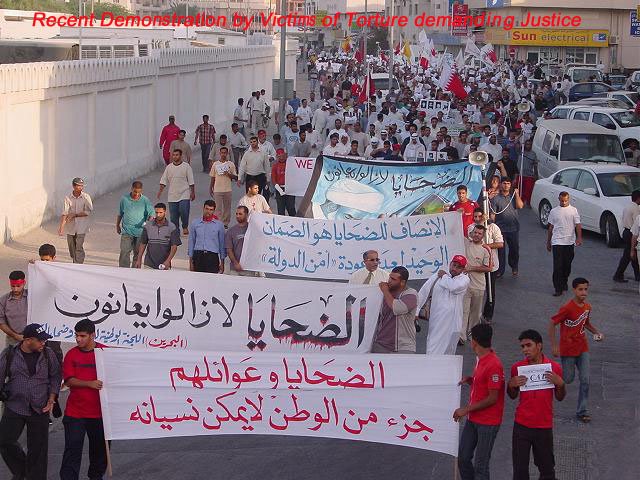
  • The State has taken all measures to prevent, stop and threaten public gatherings which were seen to talk or indicate any official misconduct and abuse of power eg. Unemployed gatherings. Gathering for Housings, Gathering of Victims of Torture.

  • The State has maintained old legislations which are in clear violation to all universal declarations, among which are the Penal, the Civic Societies, the Press and Publications and the Gathering Codes. The State has also introduced new codes which arenot compatible with all international agreements and Universal declaration, among which are the Impunity (protecting torturers from fair trials) and the new Political Societies. Furthermore, the State has drafted codes which will terminate any sign of active and normal life for activists and citizens to exercise their rights of freedom of expression. These are particularly the codes of Public Gathering and Procession (new version of the 1973 code), Combating Terrorism, and National Security.

  • The State has taken measures to dissolve human rights organizations like the Bahrain Center for Human Rights since September 2004 and physically attacked and beaten human rights activist in June and July 2005.

  • It has also taken means to harass human rights defenders in their employment and social life, taping and monitoring their personal telephone lines and emails as well as chasing and trailing defenders when meeting international activists and journalists visiting Bahrain. The State has gone further by Spreading false and antagonized sms messages about these activists and their families and prevented them from access to media and all means of reach to public through public establishments

Demands and Remedial Solutions:


  1. A democratic regime governed by a socially binding constitution enabling full and independent power of legislation and oversight have always been a popular demand by people of Bahrain. The popular struggles in Bahrain will persist until such demand is fulfilled and achieved. The will of people has to be respected and made to be the upper hand.

  2. Appointed councils should not exercise any legislative role and would respect fair representations of the Bahraini society.

  3. Election Constituencies should not intensify discrimination among citizens and should treat them equal in privileges and representations.

  4. Change of demographic plans should be stopped and ways of reversing it should be implanted to reflect good faith of protecting Bahrain original identity and culture.

  5. Embezzled coasts, islands and public lands should return to the public consumption, benefit and enjoyment. Corruption should cease and transparency should prevail.

  6. All forms of discrimination (racial, sectarian, sex, ethnic) should be stopped and criminalized and ways of correcting the situation should be pursued.

  7. Bahrainis should benefit from all wealth equally well, and practical schemes to solve unemployment and housing problems should be implemented.

  8. Old and new Legislations should not strip people from any inherent or gained rights and should not violate universal declarations and international agreements. This include all codes curtailing and limiting freedom of association, freedom of expression and rights of victims of torture.

Monday, October 17, 2005

Terrorism Code

نظرة على قانون الإرهاب المرتقب:
بعد قرع الجرس الأول على قانون الجمعيات السياسية، هذا هو الجرس الثاني
إرهاب الدولة

د.عبدالجليل السنكيس

تقديم
بعد ان استطاع النظام ان يخلق حالة من الإرهاب للمؤسسات السياسية من خلال اصدار قانون رقم 26 لسنة 2005م (قانون الجمعيات السياسية) ياتي دور إرهاب الموطنين والأفراد، وذلك من خلال تقنين التعاطي الفردي سواء من خلال الحركة الفردية او المنضوية تحت نسق جماعي. وقد طرح النظام مشروع النظام بدعوى ظاهرة ما يسمى بالإرهاب الدولي ومكافحته.

وحتى يولد القانون قاعدة قانونية، استند المشرع في تقديمه على عشرة قوانين بمراسيم أميرية وأخرى ملكية (قانون العقوبات الصادر بالمرسوم بقانون رقم "15" لسنة 1976 وتعديلاته، والمرسوم بقانون رقم "16" لسنة 1976 في شأن المفرقعات والأسلحة والذخائر المعدل بالمرسوم بقانون رقم "6" لسنة ،1996 والمرسوم بقانون رقم "21" لسنة 1996 بشأن البيئة، المعدل بالمرسوم بقانون رقم "8" لسنة ،1997 والمرسوم بقانون رقم "15" لسنة 1998 بالتصديق على الاتفاق العربي لمكافحة الإرهاب، والمرسوم بقانون رقم "4" لسنة 2001 بشأن حظر ومكافحة غسل الأموال، والمرسوم بقانون رقم "26" لسنة 2002 بالموافقة على الانضمام إلى معاهدة منظمة المؤتمر الإسلامي لمكافحة الإرهاب الدولي، وقانون السلطة القضائية الصادر بالمرسوم بقانون رقم "42" لسنة 2002، وقانون الإجراءات الجنائية الصادر بالمرسوم بقانون رقم "46" لسنة ،2002 والقانون رقم "9" لسنة 2004 بالموافقة على انضمام مملكة البحرين للاتفاق الدولي لقمع الهجمات الإرهابية بالقنابل):

تعريف الإرهاب البحريني

عرف مشروع القانون الإرهاب بانه كل استخدام للقوة أو العنف أو التهديد باستخدامه أيا كانت بواعثه وأغراضه، يلجأ إليه الجاني تنفيذا لمشروع إجرامي فردي أو جماعي، بهدف تعطيل أحكام الدستور أو القوانين أو اللوائح أو الإخلال بالنظام العام أو تعريض سلامة المملكة وأمنها للخطر أو الإضرار بالوحدة الوطنية أو أمن المجتمع الدولي، إذا كان من شأن ذلك إيذاء الأشخاص أو بث الرعب بينهم أو ترويعهم أو تعريض حياتهم أو حرياتهم أو أمنهم للخطر، أو إلحاق الضرر بالبيئة أو الصحة العامة أو الاقتصاد الوطني أو المرافق أو المنشآت أو الممتلكات العامة أو الخاصة أو الاستيلاء عليها أو عرقلة أدائها لأعمالها، أو منع أو عرقلة السلطات العامة أو دور العبادة أو معاهد العلم عن ممارسة أعمالها.

فأي عمل أو نشاط يفسره النظام او منفذ هذا القانون- وهو النيابة العامة بشكل أساسي- بانه يعطل احكام الدستور المنفرد الذي فرضه النظام على الشعب بطريقة فوقية، فذلك يعتبر ضمن تعريف الإرهاب. ولنضرب مثال: المادة 9-ز تتخذ الدولة التدابير اللازمة ن اجل تحقيق استغلال الأراضي الصالحة للزراعة بصورة مثمرة. فإذا قام شخص ما بجرف الأراضي الزراعية العامة  وحولها لعقارات وأراضي استثمارية، فيكون قد عطل احكام الدستور وبالتالي قد قام بعمل ارهابي. وإذا اشار مواطن الى دور رأس النظام الأساسي في تغيير التركيبة السكانية عن طريق التجنيس باستخدام الإستثناء الموجود في المادة 6 من قانون الجنسية- كما اشارت لذلك الحكومة في ردها على توصيات لجنة التجنيس البرلمانية- فإن ذلك يتعارض مع المادة 33-أ التي تنص على أن الملك ذاته مصونة لاتمس، فإنه بذلك عطل احكام الدستور وأصبح ارهابي، يستحق العقوبات الرادعة. واما القول بأن دستور 2002 فاقد للعقدية والشرعية، فإنه اكبر تعطيل لأحكامه، وبذلك يعد من أكبر اعمال الإرهاب.
كذلك المسيرات والإعتصامات الاحتجاجية التي تمر بالشوارع، والأراضي العامة فإنها تخل بالنظام العام وتعرقل أداء المؤسسات العامة وتعرقل اداء عملها وكذلك عمل المؤسسات الخاصة كالدكاكين والمتاجر، كما تسد الشوارع وتعيق السلطات العامة من أجهزة مرورية ووزارية من ممارسة عملها، فالقيام بكل ذلك يندرج تحت الإرهاب.

العقوبات في هذا القانون

تتراوح  العقوبات في هذا القانون بين الحبس لأكثر من 10 سنوات والإعدام، مروراً بالحبس المؤبد. ويكفي الإشارة الى المادة 6 من مسودة القانون لنعلم كيف يستعين النظام بمحاصرة النشطاء والمعارضين او من يتعاطف معهم، بعد ان فرض على غيرهم المسايرة من خلال قانون الجمعيات السياسية السيئ هذه المادة تقول:
"يعاقب بالإعدام كل من أنشأ أو أسس أو نظم أو أدار، على خلاف أحكام القانون، جمعية أو هيئة أو منظمة أو جماعة أو عصابة أو فرعا لإحداها، أو تولى زعامة أو قيادة فيها، يكون الغرض منها الدعوة بأية وسيلة إلى تعطيل أحكام الدستور أو القوانين أو منع إحدى مؤسسات الدولة أو إحدى السلطات العامة من ممارسة أعمالها"... ويعاقب بالسجن المؤبد كل من انضم إلى إحدى هذه الجمعيات أو الهيئات أو المنظمات أو الجماعات أو العصابات أو أحد الفروع أو شارك في أعمالها بأية صورة، وهو يعلم بأغراضها الإرهابية.

وقارنوا بين هذه العقوبة، وعقوبة التدريب على الأسلحة في المادة 8 التي تنص على:
"يعاقب بالسجن المؤبد أو السجن الذي لا يقل عن عشر سنوات، كل من درب شخصا أو أكثر على استعمال الأسلحة أو المفرقعات أو غيرها بقصد الاستعانة به في ارتكاب إحدى الجرائم المنصوص عليها في هذا القانون. ويعاقب بالسجن مدة لا تزيد على خمس سنوات، كل من تدرب على استعمال الأسلحة أو المفرقعات أو غيرها من التدريبات بقصد ارتكاب أي من الجرائم المنصوص عليها في الفقرة السابقة".

اما المادة 9 من القانون، فكيف يفسرها من رغب في التسجيل والتحدي في قانون الجمعيات السياسية:
يعاقب بالسجن المؤبد كل من أدار منظمة أو جمعية أو مؤسسة أو هيئة خاصة أنشئت طبقا للقانون، واستغل إدارته لها في الدعوة إلى ارتكاب أي من الجرائم المنصوص عليها في هذا القانون.

المادة 10 ترتبط بممارسة المواطنين لمعتقداتهم ومشاعرهم الدينية، إذ تنص على
"يعاقب بالحبس وبالغرامة أو بإحدى هاتين العقوبتين كل من استغل الدين أو دور العبادة أو الأماكن العامة أو المناسبات الدينية في بث دعايات مثيرة أو أفكار متطرفة أو رفع لافتات أو وضع رسوم أو ملصقات أو صور أو شعارات أو رموز من شأنها إثارة الفتنة أو التحقير من الأديان السماوية أو رموزها أو الطوائف المنتمية إليها أو الإضرار بالوحدة الوطنية أو السلام الاجتماعي أو اضطراب الأمن أو النظام العام".

أما ما يخص الترويج والاصدارات، فيأتي القانون ليوقع العقاب الشديد عليها كما يلي (المادة 12):
يعاقب بالحبس وبالغرامة التي لا تقل عن ألفي دينار ولا تزيد على خمسة آلاف دينار كل من روج أو حبذ، بأية طريقة، أية أعمال تكون جريمة تنفيذا لغرض إرهابي.
ويعاقب بالحبس مدة لا تزيد على خمس سنوات كل من حاز أو أحرز بالذات أو بالواسطة محررا أو مطبوعا يتضمن ذلك الترويج أو التحبيذ إذا كان معدا للتوزيع أو لاطلاع الغير عليه، وكذلك كل من حاز أو أحرز أية وسيلة من وسائل الطبع أو التسجيل أو العلانية أيا كان نوعها، استعملت أو أعدت للاستعمال ولو بصفة وقتية لطبع أو تسجيل أو إذاعة ذلك الترويج أو التحبيذ.

المادة 14 تحدد العقوبة لم يتصل أو يتواصل مع أي مؤسسة او هيئة او منظمة خارج البحرين:
يعاقب بالسجن مدة لا تقل عن خمس سنوات ولا تزيد على عشر سنوات، كل مواطن تعاون أو التحق بأية جمعية أو هيئة أو منظمة أو عصابة أو جماعة، أيا كان تسميتها، يكون مقرها خارج البلاد وتتخذ من الإرهاب أو التدريب عليه وسيلة لتحقيق أغراضها، إذا كانت أعمالا غير موجهة إلى مملكة البحرين..

المادة 18 تعاقب على " الشروع في إحدى الجرائم المنصوص عليها في هذا القانون بذات العقوبة المقررة للجريمة التامة". وحتى إذا لم يتم على "الجريمة" أثر، فإن القانون يعاقب كل من حرص على ارتكاب جريمة تنفيذا لغرض إرهابي أو اتفق مع غيره على ارتكابها يعاقب بالعقوبة المقررة لها، كما في المادة 19.

وفي المادة "24"، يجوز في الأحوال المنصوص عليها في هذا القانون، فضلا عن الحكم بالعقوبة المقررة، الحكم بتدبير أو أكثر من التدابير الآتية:
1- حظر الإقامة في مكان معين أو في منطقة محددة. 2- الإلزام بالإقامة في مكان معين. 3- حظر التردد على أماكن أو محال معينة.
وفي جميع الأحوال لا يجوز أن تزيد مدة التدبير على خمس سنوات. ويعاقب كل من يخالف شروط التدبير المحكوم به بالحبس مدة لا تزيد على سنة
دور الإدعاء العام

ومن حق الإدعاء العام تسنم سلطات القاضي واقرار حبس اي متهم لمدة تصل الى 90 يوما على ذمة التحقيق، لحين ثبوت الجرم، كما وصفته المادة 29. ويستخدم كل ادوات التنصت والمراقبة وضبط الرسائل بجميع أنواعها والمطبوعات والطرود والبرقيات، وبمراقبة الاتصالات بجميع وسائلها، وتسجيل ما يجري في الأماكن العامة أو الخاصة، كما أوضحته المادة 32. كما يحق له الاطلاع أو الحصول على أية بيانات أو معلومات تتعلق بالحسابات أو الودائع أو الأمانات أو الخزائن لدى البنوك أو غيرها من المؤسسات المالية أو المعاملات المتعلقة بها، كما في المادة 33. ويأمر، كما في المادة 34، بمنع المتهم من السفر أثناء التحقيق، أو أن يأمر مؤقتا بمنعه من التصرف في أمواله أو إدارتها أو غير ذلك من الإجراءات التحفظية، ويجوز أن يشمل أمر المنع من التصرف أو الإدارة، أموال زوج المتهم وأولاده القصر، إذا ثبت أن هذه الأموال قد آلت إليهم من المتهم.

الإستنتاجات

  1. أن النظام قد عزم على ملء سجونه مرة أخرى ولكن هذه المرة بالقانون المشرعن من خلال مجلس المعاق. فإن وضع الإنفتاح قد هيأ بلاشك لأنشطة احتجاجية رافضة لكثير من مواقفه وبرامجه. وسيتقدم هذا الرتل من المعتقلين، الشخصيات النشطة التي يرى فيها النظام تهديداً لبرامجه، وخططه الرامية الى تخدير الشعب وسلب ارادته وتحويله، باسم القانون، مع كل الإحترام، الى عبيد ومسلوبي الإرادة والكرامة.

  2. أن اقرار هذا القانون سيكون على يد من هم محسوبون على الشعب ومن هم يمثلونه ـ وبالتالي يكتسب هذا القانون، كما اكتسب سابقه- قانون الجمعيات السياسية- صفه يرى فيها البعض شرعية.

  3. أن هذا القانون يمثل قطعة من قوانين احكام القبضة المشرعنة والمتلبسة بقوانين النظام التي سيسعى من خلالها وبمساعدة النيابة العامة والقضاء للجم أي تحرك فردي أو جماعي، من خلال مؤسسة  مسجلة أو غير مسجلة، وسلبه أي حرية في التحرك ميدانياً والتعبير عن أي حالة رفض أو احتجاج في داخل وخارج البحرين. من هذه القوانين:أ- قانون الجمعيات السياسية للجمعيات السياسية، ب- قانون الإرهاب للمواطنين، ج- قانون التجمعات والمواكب للمؤسسات الدينية ومواكب التعزية والعزاء، د- قانون الجمعيات الاهلية للمؤسسات الثقافية والأندية، هـ- قانون النقابات. وقد سبقهم قانون الصحافة والطباعة والنشر الذي صدر قبيل انعقاد مجلس الشورى نصف المنتخب من ضمن حزمة القوانين الـ56.

  4. ان اعطاء الشرعية وتجذير قانون الجمعيات السياسية، وهو قانون الإرهاب الأول، من خلال قبول التسجيل فيه سيكون الممهد لتمرير قانون الإرهاب الثاني: قانون بشأن مكافحة الإرهاب، حيث ان القبول به سهل اقرار القوانين الأكثر تعسفية ومصادرة للحقوق الاساسية، وحينها سيكون الوقوف مستحيلاً والمقاومة ضرباً من الخيال.