Showing posts with label Non-faseela publications. Show all posts

Friday, April 18, 2008

The Economist: "Not so sunny for Shias"


Bahrain Not so sunny for Shias


Apr 3rd 2008


MANAMA


A put-upon majority feels done down—and is getting angry


THE monarchy of Bahrain regards itself as a beacon of democracy in the Middle East. It was the first in the Gulf to give all its citizens the vote, setting up a partially elected parliament, albeit with limited powers, in 2002. Yet in the past few months its officials concede that in an average week there have been more than two riots and five public protests.
Most of the unrest takes place outside the predominantly Sunni capital, Manama, in poorer, mostly Shia, villages. No official statistics are published but some villagers say that a third or even half of them have no jobs. Bahrainis are readier to work in menial jobs than their wealthier counterparts in Kuwait or the United Arab Emirates but cheap foreign workers depress wages. A typical foreign construction worker is housed in a labour camp, cannot bring his family to Bahrain and earns around $160 a month, which would barely support a Bahraini family with four or five children.
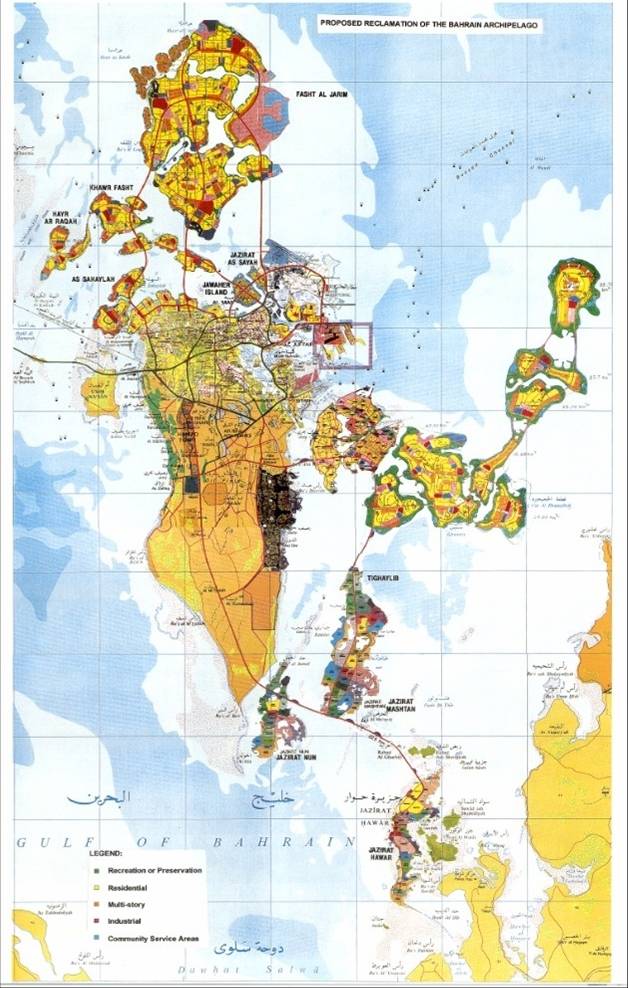
The soaring price of land is another grumbling point. Some Bahrainis have been waiting for state housing since 1992. Mortgages are hard to get. Yet the government has embarked on a grandiose campaign to reclaim land, with banks pouring cash into construction. Many of the new schemes are for fancy flats and artificial islands, like those in Dubai, and are more likely to be sold to rich Saudis or people from the emirates than to Bahrainis.
To make matters worse, these inequalities often have a sectarian tint. Most Bahrainis are Shias but the royal family is Sunni. The Shias are more likely to be jobless; many government employers discriminate in favour of Sunnis. “Recently I went for a public-sector job and they asked me what sect I was,” says a sour Shia mechanic. “But I didn't come to the garage to pray!”
Ebrahim Sharif, a former banker, heads Wa'ad, a liberal Arab-nationalist party. Himself a Sunni, he thinks Sunni and Shia Bahrainis should form a united opposition. “Most of the Shias are worse off than the average Sunni but the only first-class citizens are the royal family,” he says. However his party lost all its seats in the last election, and the parliament is dominated by Islamists of both sects.
These included the country's main Shia opposition group, Wefaq National Islamic Society, which joined parliament in 2006 after boycotting the previous election four years earlier. Its presence raised hopes of change. But voters are growing frustrated with parliament as they realise how few powers its elected members have. The government controls the pace of liberalisation. Local political activists get little support from abroad. America is wary of calling for more democracy. It fears that parliamentarians may turn against America's naval base in Bahrain, its biggest in the Gulf; last year a majority of them declared that it should not be used in any war between America and Iran. More recently the government has signed an agreement with America to help Bahrain develop peaceful nuclear technology.
Wefaq must now deal with one of the trickiest sectarian issues raised by its supporters: a widespread rumour that the government is handing out passports to Sunnis from other countries in an attempt to turn the Shias into a minority. These fears were raised in a report in 2006 by a former government adviser, Salah al-Bandar, who said he had confidential government documents revealing such a plan, The government hotly denies any such thing. The row has flared up again with the publication of government statistics that show the population jumping by 41% last year and the number of citizens growing by 15%, against a previous rate of 2.4%.
Wefaq wants to question a minister named in Mr Bandar's report. The constitution says a minister must submit to questions in parliament if five of the assembly's members so demand; in this case, 18 want the minister questioned, so far in vain. The row has paralysed parliament for the past six weeks as debates have descended into shouting matches; for one week it was suspended. A Sunni Islamist member says it should be dissolved. Wefaq is wondering whether it was sensible to have joined it.
This week, just before its officials were to attend a UN meeting to review Bahrain's human-rights record, the government said it would set up a new human-rights task-force. What a coincidence.

Tuesday, March 25, 2008

Small Island, Big Issues: Bahrain's King Visits Washington


PolicyWatch #1357

Small Island, Big Issues: Bahrain's King Visits Washington


March 24, 2008


Tomorrow, King Hamad bin Isa al-Khalifa of Bahrain visits the White House for talks and a working lunch with President Bush. The meeting promises to cover much more than the usual diplomatic pleasantries. The island state of Bahrain headquarters the U.S. Fifth Fleet and is therefore key to U.S. strategy in the Persian Gulf. The stability of this relationship faces challenges, however, given increasing divisions in the royal family, simmering discontent among the majority Shiite population, and perceived threats from Iran. Each of these issues -- particularly Iran -- will likely play a prominent role on the president's agenda tomorrow.
A Stalled State?

Once at the vanguard of developing Gulf city-states, Bahrain has now lost that position to sheikdoms like Dubai and Abu Dhabi in the United Arab Emirates, as well as neighboring Qatar. Although Bahrain's capital, Manama, has some of the glitz of other Gulf capitals, its early lead in development -- achieved during the 1970s with the creation of a dry dock, an aluminum smelter, and offshore banking infrastructure -- is no more. Similarly, political reforms appear stalled, with little or no progress made since the bicameral legislature was introduced in 2002. The 2006 elections were manipulated, if not rigged, to ensure that Shiite legislators did not win a majority. And members of the royal family still hold the majority of cabinet positions.

Perhaps most worrisome for Washington, the regime no longer seems to be exercising the canny balancing of political tensions that other Gulf rulers employ to ensure stability. Instead, Sunni-Shiite friction is being played out on the streets -- never a good way of attracting foreign investors.

Bribery Allegations
Recently, problems within the royal family have appeared on the front pages of foreign newspapers and even in the local media. In February, the Wall Street Journal reported that a Bahraini-controlled company had accused Pittsburgh-based Alcoa, one of the world's largest metals companies, of a fifteen-year conspiracy involving fraud and bribery. The original complaint asserted that Alcoa had overcharged Aluminum Bahrain (a.k.a. Alba) in certain transactions, with some of the resultant proceeds allegedly used for improper payments to a senior Bahraini official already under investigation at home. According to the Journal, that official is Sheikh Isa bin Ali al-Khalifa, who was dismissed by the king in 2005 and is now an advisor to Prime Minister Khalifa bin Salman al-Khalifa. The U.S. Justice Department is reportedly opening a criminal inquiry into the Alcoa case.

Emerging Family Confrontation
Prime Minister Khalifa is tied to other divisions in the ruling family as well. Uncle to King Hamad, he has served in his current post for thirty-seven years. Over that period, he has built a formidable position in the island's commercial life. He is also considered an efficient administrator with political skills that the king perhaps lacks. But the king and his American-educated son, Crown Prince Salman, appear increasingly concerned about Khalifa's role. In January, during an extraordinary public exchange of letters between father and son, Hamad issued a public warning that government officials resisting change would be swept aside. Possibly anticipating a coup, he dismissed the defense minister (another relative) and named Salman deputy commander-in-chief of the army, removing any ambiguity over who controls the military if the king is abroad. The prime minister himself was abroad at the time.
Disagreements have emerged on other issues as well. During a February interview, Prince Salman gave pointed remarks about recent protests, stating, "It is a free country and dissent is allowed. The demonstrations are something to be proud of." In contrast, the prime minister is considered a hardliner in dealing with political opposition. Many of those arrested during street troubles in December remain in custody, awaiting trial. Their families allege that they have been tortured.

With the support of his father, Salman is also attempting to build up an Economic Development Board as an apparent rival to Khalifa's cabinet. Established in 2000 to encourage foreign investment, the board now includes sixteen ministers, making the majority of the cabinet directly accountable to the crown prince on economic matters. In his February interview, Salman explained that the move "eliminated bureaucratic steps within the cabinet.... We do not need to discuss things twice. We do it just once and pass it along for approval [by the king]."
Yet, any hope that the prime minister, now age seventy-two, might retire appears premature. Khalifa is already taking advantage of the king's absence (Hamad visited London before traveling to Washington). For example, he told the cabinet yesterday that no effort would be spared to "seek alternatives and find solutions" to counter soaring prices, showing his political skills with promises of a onetime payment to low-income families and the establishment of special centers to ensure proper distribution.

Saudi Views
Saudi Arabia is likely to be watching King Hamad's Washington visit closely. Riyadh has long had a paternalistic attitude toward Bahrain, which is linked to the kingdom by a fifteen-mile-long causeway. The island provides a less constrained social environment for Saudi tourists, but Riyadh is concerned about the possible effect that radicalized Bahraini Shiites might have on Saudi Shiites, who form a local majority in the area closest to Bahrain -- an area that is also home to most of the kingdom's vast oilfields.

President Bush's Agenda
Although he has publicly praised Bahrain for its limited political progress in recent years, President Bush will likely use King Hamad's visit as an opportunity to suggest real sectarian power-sharing over the long term. The regime's controversial approach to "solving" its chief demographic dilemma -- that of being a majority Shiite country ruled by a Sunni royal family -- has been to import Sunnis from across the Arab world and Pakistan, giving them government jobs (often in the security services) and making them naturalized Bahrainis. Inevitably, this has increased resentment among many Shiites, who have been excluded from such jobs and political power in general. The involvement of these "new" Bahrainis in crackdowns on Shiite demonstrators has only exacerbated the tensions.

Labor reforms offer one means of mitigating these problems. High oil revenues are fueling a region-wide development boom, and rather than importing cheaper -- and potentially less troublesome -- foreign labor, the regime would be wise to include native Shiites in the growth.
President Bush and the king will also likely discuss terrorism-related issues. Although the island is not a major hub of international terrorist activity, authorities did recently uncover and prosecute an al-Qaeda cell there. The sentence was unfortunately light, but the president should nevertheless applaud the king for the investigation and encourage him to continue aggressive action against such activity (for more information on the al-Qaeda case, see PolicyWatch no. 1345).

Discussing Iran
Iran will likely be the top item on the meeting's agenda. Bahrain believes that Tehran has never really given up its territorial claim on the island -- a suspicion that Iranian clerics reinforce regularly in public comments to that effect. The king therefore has strong concerns about Iranian intentions; he will likely seek President Bush's reassurance about U.S. policy toward Iran and private promises of U.S. support in the event of a confrontation. For his part, Bush will presumably encourage aggressive follow-up action on recent U.S. sanctions against Future Bank in Bahrain, which is controlled by Iran's Bank Melli -- itself previously designated for financing Tehran's nuclear and missile proliferation activities.

Iranian issues have ruffled the U.S.-Bahraini relationship at times. Last November, for example, embarrassment resulted when Crown Prince Salman gave an interview declaring that Iran was seeking nuclear weapons, just weeks before the U.S. National Intelligence Estimate reported the opposite. Tehran would probably love to exploit any such rifts and sever the island's longstanding relationship with Washington. It likely views the uncertain state of internal Bahraini politics as an opportunity as well. Accordingly, Washington should use tomorrow's meeting as a starting point for greater vigilance toward its relations with a vital regional partner.
Simon Henderson, the Baker fellow and director of the Gulf and Energy Policy Program at The Washington Institute, is author of the 2003 Institute book The New Pillar: Conservative Arab Gulf States and U.S. Strategy.
© 2008 The Washington Institute for Near East Policy

Friday, November 09, 2007

British Press.. Why the Distortion?

British Press.. Why the Distortion?

(A translation of an editorial by Anwar Abdulrahman, Editor-in-chief: Akhbar Al-khaleej)

Original editorial in Arabic: http://aaknews.com/ArticlesFO.asp?Article=210017&Sn=ANWA

Last week, Bahrain was visited by writers and journalists from four major British newspapers are: The Times, The Independent, The Daily-Telegraph, and The Guardian. They say they are experts in Middle East issues, but by the articles they wrote about the visit after their return to Britain was a travesty of the truth of the situation in Bahrain and a talk that does not bear any degree of responsibility.

After reading their articles, one wonders, could these newspapers be really trusted after that? It is enough simply to narrate the following:
Two of these journalists, Donald Macintyre of the Independent, and Ian Black of The Guardian, paid us a visit at «Akhbar Al-khaleej«. I talked with them for an hour, and joined by two fellow colleagues, Mr George Williams and Mr. Zuhra. Discussions with them covered details on the situation in Bahrain and the region from all aspects raised by them. It was clear that the information provided was of surprise to them. They were not able to conceal their astonishment, and were reiterating, from time to time «But when we talked with Al-Wefaq, they portrayed quite a different picture«.

It was clear that they were concerned only with the negative aspects in Bahrain and want to hear all that is in this direction, especially after hearing from others on allegations of sectarian discrimination between Sunnis and Shiites.

I explained to them, in detail, how the Bahrain is a free liberal society that embraces various political and ideological schools, including schools of extremism, whether Shiite or Sunni.

But the society, in general, is a plural and diverse one, encompasses Shiite and Sunni liberals. It also includes, in the two sides, groupings of different social levels; poor, middle and wealthy. I explained to them how this talk about sectarian discrimination between Sunnis and Shiites in Bahrain is not true. I assured them that when we say this, with regard to this and other issues, we try to explain to them, as colleagues of profession, the true situation in Bahrain as it is away from any political or ideological considerations.


Throughout the talk, they were noting down everything we say. But it is very strange that the reports they wrote and subsequently publish about Bahrain, did not include absolutely none of the information that we provided, or ideas that we expressed. The only exception to that, was a citation in one of their articles, in which I said about the current Bahrain democratic experience and how to its attributed to His Majesty King Hamad bin Isa Al Khalifa who initiated it prior to the American President George Bush speech about what he claimed to be his project to spread democracy in the region. indicating that it is a pure Bahraini experience.

The issue here is that these journalists came to Bahrain and were given the opportunity to talk with everyone and listen to all views about the situation in Bahrain and the region. The simplest rules of profession and was their duty to provide to the British reader with the whole picture, and all different views in a balanced manner. But what did, is they flouted the simplest rules of the profession, and presented to the reader the only views which portray a negative image of the situation in Bahrain.
The question that must be asked is: Why? .. Why do they do it? Are they flawless neutral journalists or imposters just want to distort the truth?

It seems from what they published about Bahrain that their only intentions was to provide opinions and viewpoints challenging experience in Bahrain and talked about the negatives alone and nothing but this.

By this, they not blemish their newspapers and their readers, but also mislead their politicians. If their press coverage is biased, illusive and distortive to the reality, how can policy makers in London formulate accurate idea and have objectively fair assessment of the real situation in Bahrain?

I advise the chief editors of these newspapers to check, in the future, of the authenticity, integrity and neutrality of such reports. It is, in the end, about the credibility of these newspapers. It is certain that by the publishing such reports on Bahrain, theses newspapers have lost much of its credibility.

-------------------------------------------------- ------
The articles referred to by the editor-in-chief of Akhbar Al-khaleej:

Http://alsingace.blogspot.com/2007/11/bahrain-boom-overshadowed-by-fear-of.html Http://alsingace.blogspot.com/2007/11/bahrains-success-at-risk-as-iran.html Http://alsingace.blogspot.com/2007/11/sunni-side-up.html Http://alsingace.blogspot.com/2007/11/bahrain-accuses-iran-of-nuclear-weapons.html

Monday, November 05, 2007

Bahrain boom overshadowed by fear of looming war with Iran

Bahrain boom overshadowed by fear of looming war with Iran

By Donald Macintyre in Bahrain

Published: 02 November 2007

Stuck in one of the seemingly permanent traffic jams on the wide highways of its capital, Manama, where the colourful mosaic of the Friday Mosque's minaret competes for attention with the extraplanetarily futuristic twin towers of the World Trade Centre, you cannot easily imagine the shadow of war falling over Bahrain. But if there is a country in the region that has every reason to be apprehensive about a Western military confrontation with Iran it is the Arab world's only island state.It is not just that the Gulf kingdom is at once home to the US Fifth Fleet and nearer – 250km away – than Tehran is to the key Iranian nuclear reactor of Bashir. Or that war so near would threaten its national growth – thanks to oil, tourism, and financial services – of 7 per cent and a per capita income of $21,000 (£10,500). Or that the influential Iranian newspaper Kayhan in July carried the inflammatory claim that Bahrain was a "province" of Iran – requiring a hasty joint disavowal at a meeting of both countries' foreign ministers. Or that as recently as this week Bahrain's Gulf Daily News gave front-page prominence to a threat by a senior officer in the Iran Revolutionary Guard to launch suicide bombings in the Gulf "if necessary". There is also the potential impact on an already often restive Shia majority among the 750,000 population. At the end of a week in Britain in which the visiting King of Saudi Arabia, Bahrain's other immediate neighbour, has been castigated for the internally repressive regime he presides over, it is all the more striking that Bahrain's royal Al Khlaifa family has ushered in a – by Arab Middle East standards – progressive if so far severely limited experiment in parliamentary democracy . That experiment has seen 17 out of the 40 seats taken by Shia members of the Al Wifaq party in the parliament's elected lower house. Saudi businessmen regularly come over the causeway at weekends to savour the distinctly Western pleasures of alcohol and women available on the island. But few, if any, of the cautious steps instituted by King Hamad Bi Isa Al Khalifa towards his stated long term goal, however distant, of turning Bahrain into a "constitutional monarchy" has rubbed off on the Saudi regime. But this progress – which even moderate Shia MPs are increasingly complaining is far too slow to arrest what they and senior Western diplomats lament is still widespread discrimination by an overwhelmingly Sunni regime – is unlikely in the event of a war with Iran to contain a sectarian fallout, which in the blunt words of Bahrain's Foreign minister, Shaikh Khaled Al Khalifa, could eventually prove "worse than Iraq". Unsurprisingly, therefore, Bahrain would like some measure of influence over the Western deliberations on Iran. "I want to see the region being fully consulted," says Sheikh Salman, adding pointedly: "We were not fully consulted when the Iraqi regime was removed." This is not, he explains, because Bahrain wanted Saddam to remain in power; rather that a little of the "right advice" about which groups in Iraq to foster relations with might have led to a less catastrophic aftermath. "Iran is an even bigger issue," he suggests. "We want to be part of any arrangement that deals with Iran. We don't want to wake up one day and suddenly find our skies darken and sirens blaring on every street." This doesn't mean that Bahrain is unconcerned about what one high ranking – if anonymous – Bahraini official describes as "Iran's nuclear missile programme". It does mean, says the Crown Prince, Sheikh Salman Al Khalifa, a fresh diplomatic effort – not least by "garnering the support of the Russians" to reach, while there is still a "window of time", the negotiated solution that it is clear he strongly prefers to the "not advisable" course of a military strike. A senior official says even more bluntly that the US needs to withdraw "from the front line" and "get out of the way" in Iraq to focus on such diplomatic efforts over Iran. "The only reason the troops are [still] there is to save the face of the US administration," he adds. Internally, the threat of war can only exacerbate widespread impatience among the majority Shia both that they are failing to share in the distribution of Bahrain's wealth, and housing, and even more so that the lack of political progress since the last elections in 2006 are published – a major Al Wifaq complaint – it is impossible to give a reliable picture. Having been coaxed – not least by the US and Britain – to take part in those elections, Al Wifaq has warned that it is under pressure from harder line groups such as Al Haq which boycotted those elections to do so themselves next time unless there is further political progress. The powers of the Council of Representatives are greatly circumscribed and the King continues to appoint all ministers.As strikingly, the constituency boundaries are still drawn in a way to guarantee a Sunni majority in the Council of Representatives.A senior Western diplomat acknowledges that the "great expectations" of King Hamad in these areas has not so far been fulfilled and adds that while there has been a "huge amounts of positive change" the continued constituency gerrymandering of constituencies is "ridiculous". Despite frequent accusations that many Shia look to Iranian and Iraqi clerics for leadership – and much less bankable claims that they harbour Iranian-inspired "sleeper cells" – one diplomat also discounted the idea that the Shia of Bahrain are "willing agents and puppets of a malevolent Shia regime in Iran" rather than "loyal, patriotic, and looking after their own interests". That view is unsurprisingly shared by Dr Jassim who regards the moderate and non-fundamentalist ruling AKP party in Turkey as a model for his own. Nevertheless – like most of the (Sunni) Bahrain leadership he badly wants to see a negotiated solution to the Iranian crisis. "If there is an attack on Iran many people will see it as an attack on the Shia religious establishment," he says.

Bahrain's success at risk as Iran tension rises

Bahrain's success at risk as Iran tension rises

By David Blair in Manama
Last Updated: 2:34am GMT 02/11/2007

The glass skyscrapers dominating Bahrain's horizon are a glittering emblem of the Gulf kingdom's booming economy.
Yet this increasingly prosperous island will almost certainly be in the crosshairs of Iran's military planners as they consider their response to any American attack.

Bahrain hosts the US Fifth Fleet and serves as the headquarters for Allied naval operations across 2.5 million square miles of ocean. Moreover, about two thirds of Bahrain's people share the Shia Muslim faith of Iran's theocratic regime.
Bahrain's military importance for the West, combined with its Shia majority – found nowhere else in the Arab world save for Iraq – could render it vulnerable to attack from without and Iranian-inspired subversion from within.
All this preys on the minds of the country's leaders. After inheriting the throne eight years ago, King Hamad bin Isa al-Khalifa allowed dissidents to return from exile and introduced democratic reforms.
The Lower House of Bahrain's National Assembly is freely elected, independent newspapers are allowed to criticise the government and a booming, open economy, no longer dependent on oil, is delivering annual growth rates of seven per cent.
Yet the possibility of another Gulf war, the fourth since 1980, casts a long shadow. Sheikh Salman bin Hamad al-Khalifa, the Cambridge-educated Crown Prince, described the threat as "deadly serious".
Speaking inside his marbled palace in the capital, Manama, he added: "We need to be very well aware that this could escalate. And we think that is not advisable."
Iran officially denies any ambition to build a nuclear weapon and Arab leaders have generally refrained from publicly contradicting this assurance. But Sheikh Salman was candid about his view of Teheran's ambitions.
He advocated "talking to the Iranians while we still have a window of time.
"They don't have a bomb. They're developing one, or they're developing the capability to have it. There is still time to talk."
A new Gulf war would risk inflaming sectarian divisions among Bahrain's 800,000 people. The Sunni monarchy coexists uneasily with the island's Shia majority.
While King Hamad's democratic reforms have given the Shias a political voice – they hold 17 of the 40 seats in the Lower House –they are still excluded from sensitive posts.
The authorities fear that some Shias owe their loyalty to Iran, only 170 miles away, and few have been entrusted with membership of the defence forces or security agencies.
Mansoor al-Jamri, the editor-in-chief of al-Wasat, an independent daily, said there was a wider problem. "There is systematic discrimination against the Shias. Shias are not trusted by the state."
Tensions sparked by the war in Iraq caused Shias to be viewed with greater suspicion and "intensified" discrimination.
"Probably we are living in one of the worst periods of discrimination," said Mr Jamri. "This is poisoning Bahraini society."
The authorities have been accused of granting Bahraini citizenship to thousands of foreign Sunnis in order to counter-balance the Shia majority.
Privately, officials acknowledge the minimal representation of Shias in the armed forces. But Sheikh Salman said he would never doubt the loyalty of any Bahraini citizen. Economic success is one of the keys to national harmony, he added. But that success would be at risk if another war broke out.
Yet Sheikh Khalid bin Ahmed al-Khalifa, the foreign minister, said America had not consulted Bahrain on its approach towards Iran. "We don't want to wake up one day and see our skies dark, our sirens blaring on every street corner because of attacks here and there, planes flying and missiles falling," he said.
Information appearing on telegraph.co.uk is the copyright of Telegraph Media Group Limited and must not be reproduced in any medium without licence. For the full copyright statement see Copyright

Friday, November 02, 2007

Sunni side up

Sunni side up

Bahrain's ruling dynasty fears a US attack on Iran could inflame tensions with the country's restive Shia majority, reports Ian Black from Manama Friday November 2, 2007

Guardian Unlimited

It is late morning in the Bahraini parliament and deputies are debating the small print of a law on reciprocal employment rights with other Gulf countries. Sheikh Ali Salman, the leader of the Islamist opposition group al-Wifaq, is making a point in elegant, classical Arabic - his white dishdasha and matching turban magnified onto a giant video screen. Shortly afterwards, the Speaker calls a break - just time for a quick fruit juice or noon prayers on thick Persian carpets.

This everyday scene in Manama is unremarkable, but it is evidence of a smoothly functioning - if limited - parliamentary system in one of the most fragile regions on earth. And with a crisis looming over the nuclear ambitions of its Iranian neighbour, Bahrain's uncomfortable position on the great fault line of the Muslim world is being keenly felt. The split is clear just from gazing down at the chamber from the visitors' gallery. Sheikh Salman and colleagues are immediately recognisable as Shia Muslims. A couple of them in black turbans are sayyids - senior religious scholars. Some are in western suits. Other MPs wear Sunni headdresses over their robes.

The official emphasis is on Bahrain as a nation. "We are Bahrainis first, opposition or not," insists the Crown Prince, the American-educated Sheikh Salman Al Khalifa."It's dangerous to think of things here in terms of Sunni and Shia," warns police brigadier Tareq bin Dina. It may be undiplomatic for a visitor to dwell on what are dismissed as "sectarian" issues, but it is impossible to avoid them."Everyone here knows who is from which community," volunteered Hashim, a young man whose ID card (middle names - Hussein and Ali) give away his Shia faith.Black flags strung between the minarets of mosques in a town south of Manama echo the Shia centres of Najaf in Iraq, Qom in Iran and the southern suburbs of the Lebanese capital Beirut.

Bahraini Shia homes often display pictures of Ayatollah Khomeini or Iran's current supreme leader, Ayatollah Khamenei - religious icons as well as political leaders.Statistics are hard to come by (probably deliberately) but estimates suggest Shia Muslims form two-thirds of Bahrain's population of 750,000 (a figure itself open to question).Shia political groups boycotted the election in 2002 but al-Wifaq ("Accord") changed tack last year to take 17 out of 40 seats in the house of representatives (an upper chamber is appointed by the king) despite crude gerrymandering that made it far easier for Sunnis to win.King Hamad is widely praised for the reforms of the last five years, but the political climate - the "war on terror", the invasion of Iraq, Israel's war with Hizbullah - has been tough.

"His Majesty made these decisions before George Bush brought his cowboy democracy to this part of the world," sneers Anwar Abdel-Rahman, the outspoken editor of the pro-government daily Akhbar al-Khalij.Bahraini Sunnis like Mr Abdel-Rahman watched with alarm as the "Shia crescent" snaked its way across their small island - the size of Singapore - bringing mass demonstrations onto the streets in solidarity with the embattled Shias of Iraq and Lebanon, reinforcing old communal prejudices.Signs of nervousness are clear in a murky story of the naturalisation granted to an unknown number of non-Bahraini Sunnis - as many as 40,000 according to al-Wifaq.

Judicial gagging orders prevent discussion but this is a highly charged issue. The government says it is about importing skills, while critics complain the goal is to alter the demographics to boost Sunni dominance.Evidence of discrimination is rife. Shias cannot serve in the armed forces and few occupy senior official positions elsewhere. Recently Shias have found they cannot buy land in Sunni areas."There is a tendency in the establishment to make sure Sunnis stay on top and keep the Shias down and out of sight," says one foreign observer.
There is gossip about divisions within the Al Khalifa dynasty, with the crown prince constrained by conservative figures who have the ear of his father. They are influenced by the Saudis, who brook no nonsense from their own Shia minority in the oil-rich eastern provinces across the causeway from Bahrain.Still, the government is wise to modern ways of branding strategies, marketing and slick PR. (I was one of a group of journalists invited to visit Manama on an official trip this week.) And it does have a good story to tell about being the Middle East's freest economy.Bahrain's oil reserves, small compared to its neighbours, are running out, though record high prices are still helping fill state coffers.Diversification is well advanced and the financial services industry is the main source of revenue. Growth is a healthy 7%, though efforts to reduce dependence on expatriate labour have been halting.Worryingly, though, suggest both Bahrainis and foreigners, there is sense that the political part of the reform process has ground to a halt.
Al-Wifaq acts like a loyal opposition but it urgently needs progress that can justify taking part in the next election. "We are under extreme pressure," says MP Khalil al-Marzooq.Iran looms large on the horizon, but although there is talk of Iranian support for Shia activists there is no proof of it, let alone of the sinister "sleeper cells" run by Hizbullah or the Revolutionary Guards.These, in theory, would be activated throughout the Gulf if the US or Israel attacked Iran.
"The Bahrainis have no evidence, but I think they believe it," says a western diplomat."Iranian influence has been exaggerated beyond all imagination and that helps justify repressive measures," argues Mansour al-Jamri, a former exile and now editor of the opposition paper al-Wasat.
Historic mistrust of Iran deepened when President Ahmadinejad came to power and there was a major upset this summer when the editor of the Iranian Kayhan newspaper (close to the Tehran regime) called Bahrain part of Iran - an echo of Saddam Hussein's claim on Kuwait."That," says the foreign minister, Sheikh Khaled, "was very disturbing."Bahrain, home to the US 5th fleet, is likely to be a target for retaliation, like Qatar next door with two big American airbases, if President Bush decides to hit Iran's nuclear facilities. One of them, Bushehr, is directly across the Gulf."If a war starts anything can happen," Sheikh Khaled cautions. "Iran is led by a Muslim Shia theocracy.
It is difficult to see it under attack and Shias in Bahrain keeping quiet. A conflict between Iran and the world in this region will be catastrophic. We do not want to wake up one day and see skies black and hear sirens blaring. We are much closer to Iran than Washington is."The opposition agrees. "War could cause more than physical destruction," warns the al-Wifaq MP Jasim Ali. "An attack on Iran will be seen in Bahrain as an attack on the Shia establishment. The sectarian divide will grow. If there is a war then everything else will stop. It'll be security first - and nothing else."

Email: ian.black@guardian.co.uk

Bahrain accuses Iran of nuclear weapons lie

From The Times
November 2, 2007

Bahrain accuses Iran of nuclear weapons lie

Giles Whittell in Manama

A polished silver Spitfire on the desk of Crown Prince Salman bin Hamad bin Isa al-Khalifa recalls two centuries of close and cordial ties between Britain and Bahrain.
But even its most powerful friends cannot guarantee the security of this strategic island caught in the Gulf between worsening Iranian threats and “deadly serious” talk of a US military strike.
It is not a position from which to mince words. In an interview with The Times the Crown Prince has become the first Arab leader to jettison the language of diplomacy and directly accuse Tehran of seeking nuclear weapons.
“While they don’t have the bomb yet, they are developing it, or the capability for it,” he said – the first time one of Iran’s Gulf neighbours effectively has accused it of lying about its nuclear programme.
The Crown Prince also gave a blunt warning that “the whole region” would be drawn into any military conflict and called on India, as well as Russia, to help find a diplomatic solution. “There needs to be far more done on the diplomatic front,” he said. “There’s still time to talk.”
If there is a front line in the looming confrontation between Iran and the Arab world, Bahrain is on it.
The US Fifth Fleet is based here, its main carrier battle group tasked with securing the Strait of Hormuz. The King Fahd causeway to Khobar makes Bahrain a gateway to the richest oil reserves on Earth in eastern Saudi Arabia.
The Iranian coast is ten minutes away by fighter or medium-range missile. And this week a senior Iranian general said that suicide bombers were ready to strike at targets throughout the Gulf “if necessary”. Such rhetoric will focus minds in Qatar, Riyadh and the United Arab Emirates. But its effect is especially chilling in Bahrain as the only Sunni-led country with a Shia majority that is not at war or on the brink of war.
“We are a country like Iraq and Lebanon, and we are the only one that is functioning properly,” said Sheikh Khalid al-Khalifa, the Foreign Minister.
Bahrain’s Shias – and the carnage in Iraq to the north – make the kingdom a vital experiment in sectarian coexistence. So far the Shias have repaid the Royal Family’s efforts at political reform with consistent professions of loyalty. That could change overnight in the event of an attack on Iran.
Already, large-scale demonstrations are not unusual. When the Golden Mosque in Samarra was bombed by al-Qaeda in Iraq last year, and again when Israel invaded Lebanon, “Bahrain turned yellow with Hezbollah flags”, according to one Western diplomat.
Since then a reform process that started with the release of all political prisoners in 2000 has largely stalled and leading Shia figures have complained about “systematic discrimination” by the Sunni Establishment. A scandal over alleged plans to end the Shia majority by granting fast-track citizenship to tens of thousands of foreign-born Sunnis has proved so inflammatory that an otherwise relatively free press has been banned from covering it.
The Crown Prince rejected claims of discrimination but acknowledged that the broader sectarian issue had become “so politically charged that nobody is really willing to have a rational discussion about it”.
Iran has not helped. In a newspaper editorial this summer, a close associate of President Ahmadinejad rekindled an old claim on Bahrain as Iran’s 14th province, with echoes of Saddam Hussein’s designs on Kuwait in the late 1980s that were picked up from London to Washington. The claim “touched on the legitimacy of our country”, the Foreign Minister said.
There is no suggestion – yet – of an Iranian invasion of Bahrain. But even as the kingdom throws up skyscrapers to compete with Dubai and Abu Dhabi for regional financial dominance, its security forces are on high alert for evidence of Iranian-backed “sleeper cells” that could bring them all tumbling down.
Between Bahrain’s two tallest office towers three giant wind turbines are suspended in a brave vote of confidence in a future of eco-friendly peace and prosperity. Without a diplomatic end to the Iran crisis, that confidence may soon look misplaced. But the alternatives – a military strike on Iran and a regional nuclear arms race – are too bleak to contemplate.

http://www.timesonline.co.uk/tol/news/world/middle_east/article2789056.ece?print=yes&randnum=1194040225890

Monday, July 30, 2007

Strategic rift in Bahrain's royal court

http://www.latimes.com/news/nationworld/world/la-fg-bahrain7jul07,1,7501416,full.story?ctrack=1&cset=true

From the Los Angeles Times
Strategic rift in Bahrain's royal court

Some members of the ruling family reportedly back hard-line Sunni groups; others advise helping disenfranchised Shiites.ط
By Borzou Daragahi
Times Staff Writer
July 7, 2007
MANAMA, BAHRAIN — Leading members of Bahrain's royal family have thrown their weight behind hard-line Sunni Muslim groups, some of whom share the outlook of Al Qaeda, in an attempt to counter a perceived Shiite threat, government officials and critics say.The strategy, first exposed in a government report that surfaced last year, has revealed a rift within the court of the ruling Khalifa family. One faction believes in reconciliation with the Persian Gulf nation's disenfranchised Shiite Muslim majority. The other believes in suppressing Shiite aspirations, even if it means supporting Sunni groups propelled by the same ideologies that inspire Osama bin Laden. A ranking government official who is a member of the royal family said there was "no doubt" that a hard-line movement existed within the Bahraini power structure."Then, there are the moderates who believe that cohesion is the way to go forward," he said.The official, who counts himself among the moderates, spoke on condition of anonymity because of the sensitivity of the issue. Members of the royal family are unanimous in public, and analysts say they rarely discuss internal rifts. But Bahrain, a small, oil-rich nation of 750,000 people where the U.S. Navy's 5th Fleet is based, is anything but united.It rests uneasily on the increasingly volatile sectarian fault line rattling the Middle East. Impoverished Shiites, some of whom share close religious and cultural ties to Iran, demand more power from the dominant Sunnis, who have ties to Saudi Arabia. Intermarriage between the sects has become rare. Bahrain's Shiites and Sunnis have different last names and speak Arabic with different accents. Crown Prince Salman ibn Hamed Khalifa, a 37-year-old graduate of American University in Washington and Cambridge University in England, leads the moderates, who have focused on creating job opportunities for Bahrain's young as a way of staving off sectarian tensions. Khalid ibn Ahmed Khalifa, minister of state for royal court affairs, is known as the leader of the hard-liners. Few know where King Hamed ibn Isa Khalifa, the ultimate authority in Bahrain, stands. "The royal court minister is backed by the Sunni extremists and he backs them," said one Bahraini analyst, who spoke on condition of anonymity. "It's a very dangerous game. They're going down a slippery road." Even opposition figures say that the most extreme of their nation's Sunnis are moderate compared with Al Qaedainspired insurgents fighting governments in Iraq, Lebanon and Afghanistan. One Sunni hard-liner has said he welcomes the presence of American and British military officials in Bahrain if it keeps the Iranian influence at bay.Yet secular and Shiite Bahrainis
have become alarmed by the growth of Sunni fundamentalism. Figures allied with the Muslim Brotherhood or more extreme groups have gained the upper hand over the ministries of information, finance and large parts of the military, government critics and human rights groups say. Banks owned by Muslim charities or organizations have grown rich with the return of Arab funds from the United States and Europe after the increased post-Sept. 11 scrutiny of Persian Gulf money in the West. Islamic charities have morphed into powerful political groups, with the government's encouragement, critics say. Some likened the rapid buildup of Sunni groups to the U.S. and Saudi support for Islamist Afghan warriors during the 1980s Soviet occupation."This is the Saudi Frankenstein," said Ebrahim Sharif Alsayed, a member of the National Democratic Action Society, a secular opposition group. "I don't think terrorism is a serious threat. But this is the
same play. They think they can manage the Islamists." Critics worry that in a country long a bastion of relative moderation, clerics are glorifying holy war. Islamic newspapers have grown more strident and anti-American. One, Akhbar Khaleej, refers to Bin Laden as a "sheik," a title of honor.Two controversial Sunni figures who left the United States have found refuge and employment in Bahrain: Wagdy Mohammed Ghoneim, the head of an Orange County mosque who was suspected of giving speeches in support of terrorist organizations and arrested in November 2004 on suspicion of overstaying his U.S. visa; and Salah Soltan, a scholar. "Every week they appear on television, telling people how to be clean and religious and pious," said one journalist who spoke on condition of anonymity for fear of retribution. Evidence of government support for Sunni extremists first emerged in a report prepared by former government official Salah Bander, which
detailed ties between regime officials and hard-liners as part of a plan to crush Shiite aspirations.Sunnis' fear of the country's Shiite majority has been heightened by events in Iraq, where newly empowered Shiites rule over the once-dominant Sunni minority.Though shimmering with ostentatious wealth, Bahrain has not been immune to political and sectarian violence. Shiites say that for decades they've received a disproportionately small share of the country's riches and opportunities. Shiite districts west of Manama, the capital, tend to be poor and run-down. Independent observers have criticized the government for regularly staffing security forces with non-Bahraini Sunnis.Anger and resentment bubbled up in the 1970s. And in 1981, a group of Bahraini Shiites, allegedly backed by elements in Iran, attempted to overthrow the monarchy. Violent clashes between Shiites and security forces erupted in the late 1990s, sending prominent
Shiites into exile. Many Sunnis regard Bahrain's Shiites as an Iranian fifth column."Sunnis and Shiites are all in the same boat," said Mohammed Khaled, a Sunni lawmaker who has been described as a hard-liner. "But we won't allow anyone to guide that boat. We will not accept any foreign interference, not from the Americans nor the Iranians."Many of Bahrain's Shiites maintain strong ties to the burgeoning Shiite movements throughout the Middle East. The homes and cars of pious Shiites are adorned by posters of the leader of the Lebanese militant Shiite group Hezbollah, Sheik Hassan Nasrallah; Iraqi cleric Grand Ayatollah Ali Sistani; and Iranian supreme leader Ali Khamenei. King Hamed launched a plan of reconciliation and democratic reform when he ascended to the throne in 1999, but many say it has stalled, in part because of fears that giving Shiites more power would open the way for an Iranian takeover of the island nation, over which Iran
once claimed sovereignty.Moderates in the government, including the crown prince, argue that democratic reform and economic opportunity will be far more effective in coaxing Shiites away from Iran."The hard-liners haven't succeeded," the government official said. "They have only done one thing: turn a lot of people against them."

Thursday, July 26, 2007

BBC- Crossing continents: UNREST in PARDISE

** Unrest in paradise **

Bill Law asks if social and religious tensions could destabilise the important island nation of Bahrain.

To listen the full program click

http://www.bbc.co.uk/radio4/news/ram/crossingcontinents_20070726.ram


Map of Bahrain

Crossing Continents
Thursday 26 July 2007
At 1102 BST on BBC Radio 4

International campaign to prosecute Bahrain's butcher- Ian Henderson


Bahrain: Launching a multi-language campaign, in all world languages, against Henderson with the help of websites and blogs

Manama, 25 July 2007

Begin now and support justice,Selected Banners for your blog or website from here http://byshr.org/?p=51


Bahrain Youth Society for Human Rights (BYSHR) launched a campaign, today, to call for “trying the butcher of Bahrain, the British Officer, Ian Henderson.” The campaign started on 23 July 2007; i.e. one day after Henderson's arrival to Bahrain. BYSHR attributed a special section on the website (http://www.byshr.org/) for monitoring Henderson's case.

BYSHR clarified that the next step of the campaign shall focus on spreading the word in almost all universal languages: (Arabic, English, French, Spanish, Persian, Russian, Dutch, Swedish, Danish, Urdu, Turkish, Chinese).

BYSHR asserted that this step will be implemented through designing some banners in different languages. These banners will be distributed via international, regional, and local online forums and blogs. The moderators of targeted blogs and online forums will be asked to post the banners on prominent places on their websites. Bloggers and online forums moderators will be allowed to select their preferred language.

BYSHR pointed out that a special section on the website will be dedicated to trace the websites and blogs that support the campaign. That is in order to identify the websites interested in promoting international justice and advocating human rights. Simultaneously, this will also help to recognize other blogs and websites which do not care for bringing justice for all humans. Those who will post the banners are requested to notify BYSHR in order to enlist their websites on “Human Rights Supporters Section”. (If you put campaign banners on your site or blog, sent us the name of your blog or site to solidarity@byshr.org)
BYSHR stated that each of Mideast Youth – Thinking Ahead (http://www.mideastyouth.com/) and Softcopy Translation Center for NGOs (http://www.softcopytranslation.org/) participated in the campaign through providing translation and technical solutions.

Bahrain Youth Society for Human Rights have great expectations that all international, regional, and local websites and blogs will support BYSHR campaign against Henderson, the British officer accused of committing inhuman crimes in Bahrain in 1966-2000.
_______________________________________________

Bahrain Youth Society For Human Rights

Mohammed AL-Maskati

President

P.O BOX : 18597 - bahrain


Mobile : (+973)39813867

Tel : (+973)17643721

Fax : (+973)17643721

Sunday, July 22, 2007

Bahrain: Unrest in Paradise

http://news.bbc.co.uk/1/hi/programmes/crossing_continents/6904866.stm

Unrest in paradise

Crossing Continents
Thursday 26 July 2007
At 1102 BST on BBC Radio 4

Bahrain is increasingly featured in holiday brochures as a relaxing winter-sun destination for the weary north European.

The image Bahrain projects is one of a wealthy, progressive and open society - an evolving Arab democracy.

But there is a different story behind the prosperity and glitz.

This strategically positioned nation in the Gulf is wrestling with social and religious divisions that at times explode into riots.

Unlike the other Gulf states, Bahrain has a Shia majority. But its rulers, the Al Khalifa royal family, are Sunni.

Although there is a recognisable Shia middle-class, it is in the poor Shia villages where tensions are most pronounced.

Within hours of arriving in Bahrain, Bill Law finds himself in the middle of a riot in the fishing village of Malkiya.

Rubber bullets are fired and the acrid smell of tear gas lingers in the night air.
Land and coastline are at a premium in Bahrain, and the Shia villagers claim they are being denied access to fishing waters by one of the King's cousins.
Their protests are met by heavy-handed policing from a force dominated by Sunni officers imported from other countries in the region.

In Crossing Continents, Bill Law explores allegations of discrimination in Bahrain.
Do the tensions threaten to destabilise this important island nation - ally of the West and home to the US 5th Fleet?

BBC Radio 4's Crossing Continents will be broadcast on Thursday, 26 July 2007 at 1102 BST.
It will be repeated on Monday, 30 July 2007 at 2030 BST.

Presenter: Bill LawProducer: Linda PresslyEditor: Maria Balinska

Saturday, July 21, 2007

Is it acceptable to continue giving a blind eye to the butcher and torturer?


Blind Eye to the Butcher (Torture in Bahrain)

24 min 22 sec - 30-Sep-2006

Description:

Carlton ITV1 documentary from 2002 about Ian Henderson, the British head of Bahrain's secret police, accused of torturing Bahrainis. Despite the allegations of torture documented by Amnesty International and Human Rights Watch, Henderson continues to reside in Bahrain as a guest of the Bahraini ruling family.

http://video.google.co.uk/videoplay?docid=8207296200885546643&q=bahrain&pr=goog-sl